How We Fixed 179 Bugs and Cut a 55-Second App Response to Under 1 Second
Case Study - App Engineering & Recovery
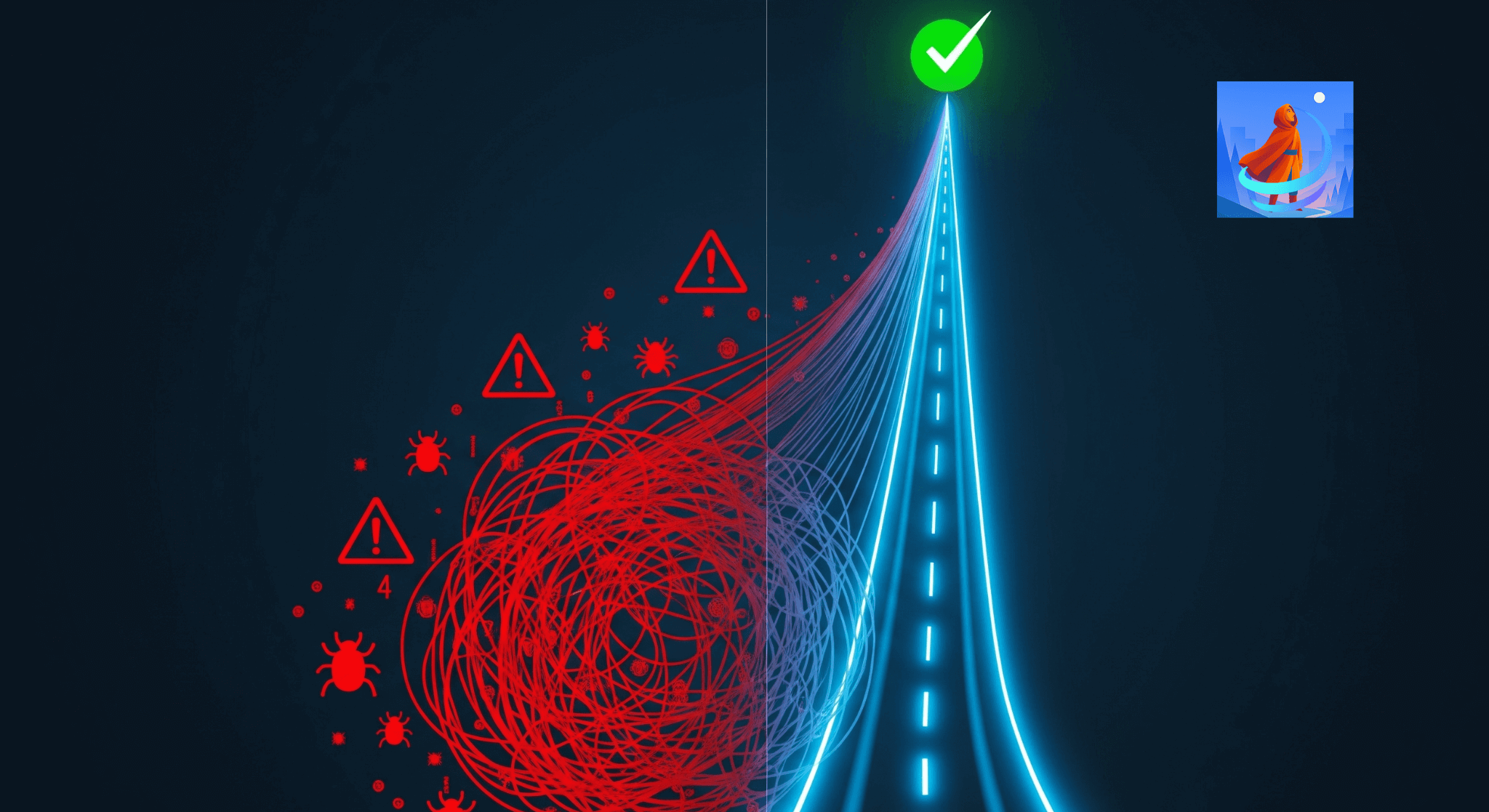
How Auriga IT rescued a gamified self-growth platform from systemic collapse - eliminating 179+ bugs, cutting a 55-second API response to under 1 second, and reducing the recommendation engine error rate from 90% to zero.
Published: 24 July 2025 · By Auriga IT · App Engineering · EdTech Recovery
179+
Documented Bugs Resolved
55s to 1s
API Response Recovery
90% to 0%
Recommendation Engine Error Rate
120+
Critical and High Severity Bugs
3
Phases of Recovery
0%
Journey Module Error Rate
01 - About the Client
Upvrd
Upvrd is an ambitious gamified self-growth and EdTech platform that guides users through personalised Life Worlds and Masteries with a narrative-driven journey system, multi-layered challenge mechanics, an in-app economy, and a recommendation engine. At launch the platform was commercially unviable due to systemic instability across every core user flow.
UPVRD
Upvrd
Self-Growth & EdTech Platform
Upvrd is an ambitious self-growth platform designed to guide users through a gamified universe of personal and professional development. The app delivers a deeply personalised experience where users move through narrative-driven journeys, explore Life Worlds and Masteries, and engage with a multi-layered challenge system supported by a complex in-app economy and recommendation engine.
02 - Challenges Faced
Systemic Instability at Launch
Upvrd launched with four critical failure categories: 179+ documented bugs including a completely broken OTP sign-up flow, core features like search, profile management, and highlights that were entirely non-functional, data integrity failures that prevented real-time progress and coin balance tracking, and crippling performance bottlenecks including a 54.8-second API response and a 90% recommendation engine failure rate.
While Upvrd's vision was ambitious, its launch state was defined by systemic instability. Critical user flows were broken, core product pillars were unreliable, and performance bottlenecks made the application commercially unviable.
01
179+ Documented Bugs
Core user flows were broken, including a completely non-functional OTP verification system that blocked all new sign-ups from day one.
02
Core Feature Paralysis
Search, profile management, and My Highlights were inoperable, failing to return results or save user data reliably across the app.
03
Data Integrity Failures
The app failed to track user progress or update coin balances in real time, undermining the trust required for a gamified platform.
04
Crippling Performance Bottlenecks
A key API averaged 54.8 seconds per response while the recommendation engine failed 90% of the time, breaking the core personalization promise.
03 - Solutions Developed
A Strategic Three-Phase Technical Overhaul
Auriga IT deployed a three-phase recovery: Phase 1 was emergency triage and stabilisation covering 179+ bugs and broken authentication. Phase 2 was performance re-architecture covering API optimization, database query refactoring, and recommendation engine hardening. Phase 3 was process refinement covering QA, regression testing, code review, and monitoring.
Auriga IT deployed a methodical recovery strategy to stabilize Upvrd, eliminate launch-blocking issues, and transform the application into a performant, market-ready product. Each phase built on the previous one - from emergency triage through architectural repair to long-term process maturity.
1
Phase 1 - Triage and Stabilisation
The first priority was immediate product rescue. Auriga IT systematically attacked the 179+ bug backlog, repaired the broken OTP authentication flow, restored global search, profile management, and highlights, and patched unstable APIs so the core end-to-end user journey could function again.
Phase 1 Outcomes
OTP Recovery
New user sign-ups were unblocked by restoring the complete authentication and verification flow.
Feature Restoration
Critical product surfaces like search, profile management, and user highlights were fully repaired.
End-to-End Stability
Broken APIs were patched to stop systemic failures across the primary user journey.
2
Phase 2 - Performance Re-architecture
With baseline stability restored, Auriga IT re-architected the most inefficient backend services. API pagination and database query optimization eliminated the 54.8-second response bottleneck, while stronger resilience and fallback handling transformed the recommendation engine from a 90% failure rate to zero.
Performance Recovery Focus
API Pagination
Large payload bottlenecks reduced by reworking data-fetch endpoints to return results more efficiently.
Database Query Optimisation
Inefficient database interactions refactored to bring critical API response time below one second.
Recommendation Engine Hardening
Error handling and fallback mechanisms ensured the engine returned content instead of crashing at 90% failure rate.
3
Phase 3 - Process Refinement
The final phase focused on making recovery sustainable. Auriga IT introduced structured QA practices, regression testing, code review standards, and performance monitoring so the application could continue improving without slipping back into instability.
Long-Term Quality Measures
QA Discipline
Structured QA and testing workflows reduced the chance of recurring failures in future releases.
Regression Protection
Regression testing protocols established to preserve critical product stability over time.
Engineering Standards
Code review and performance monitoring embedded higher quality practices into the development process.
04 - Recovery Architecture
What Powered the Turnaround
The Upvrd technical recovery used six intervention types: systematic bug triage clearing 179+ issues, OTP flow repair restoring user acquisition, API pagination and query optimization cutting response time from 55 seconds to under 1 second, recommendation engine fallback hardening eliminating the 90% error rate, and QA and code review processes to sustain stability long-term.
Category
Intervention
Role
Bug Triage
Systematic Backlog Elimination
Resolved 179+ documented issues and cleared the launch-blocking failure backlog.
Authentication
OTP Flow Repair
Restored user sign-up capability and stabilized the onboarding journey.
API Layer
Pagination + Query Optimization
Reduced a 54.8-second data-fetch API response to under 1 second.
Recommendations
Fallback + Error Handling
Brought the recommendation engine error rate from 90% to zero.
Quality
Regression + QA Process
Introduced long-term protection against future instability and broken releases.
Engineering
Code Review + Monitoring
Improved release discipline and performance visibility as the platform matured.
05 - Results and Business Impact
From Technical Rescue to Market-Ready
The Upvrd technical recovery delivered four headline results: API response cut from 55 seconds to under 1 second (55x improvement), recommendation engine error rate from 90% to 0%, 179+ bugs resolved including all critical and high-severity issues, and the platform transformed from commercially unviable to market-ready.
Metric
Before
After
Book Data API Response Time
~55 seconds
Under 1 second
Recommendation Engine Error Rate
90%
0%
Journey Module Error Rate
25%
0%
Critical and High-Severity Bugs
120+
0
55x Faster API Performance
A 54.8-second API response reduced to under 1 second through pagination and query optimization, eliminating app freezes entirely.
Zero Error Rate
The recommendation engine moved from 90% failure to 0%, restoring the product's core personalization promise to all users.
179+ Bugs Resolved
All critical and high-severity launch issues eliminated, including the broken OTP flow that was blocking all new user acquisition.
Market-Ready Product
The intervention transformed an unstable and commercially unviable application into a stable, high-performance platform ready for growth.
06 - Frequently Asked Questions
Questions About the Upvrd Technical Recovery
What was the main problem Upvrd faced at launch?
+
Upvrd launched with systemic instability across core user flows including a completely broken OTP authentication flow that blocked all new sign-ups, 179+ documented bugs, non-functional search and profile features, data integrity failures, a 54.8-second API response, and a recommendation engine failing 90% of the time.
How many bugs did Auriga IT resolve in the technical recovery?
+
Auriga IT resolved more than 179 documented bugs, including over 120 critical and high-severity issues that were blocking core user journeys. All critical and high-severity bugs were eliminated by the end of the recovery engagement.
How much did API performance improve after the re-architecture?
+
A key data-fetching API response time was reduced from approximately 54.8 seconds to under 1 second - a 55x improvement - through API pagination and database query optimization in Phase 2 of the recovery.
What happened to the recommendation engine error rate?
+
The recommendation engine error rate was reduced from 90% to 0% by implementing stronger backend resilience, fallback logic, and improved error handling - transforming the core personalization feature from broken to reliable.
What was the three-phase recovery approach used by Auriga IT?
+
Phase 1 was emergency triage and stabilization covering the 179+ bug backlog and broken authentication. Phase 2 was performance re-architecture covering API optimization, database query refactoring, and recommendation engine hardening. Phase 3 was process refinement introducing QA, regression testing, code review standards, and performance monitoring.
Can Auriga IT help if my app has severe bugs or performance issues after launch?
+
Yes. The Upvrd case study demonstrates Auriga IT's capability to take over a critically unstable application, systematically resolve 179+ bugs, re-architect underperforming backend services, and introduce engineering processes that sustain long-term product stability. If your app is experiencing similar issues, Auriga IT can deploy the same three-phase recovery approach.
Is Your App Holding Back Your Product?
Whether you are dealing with critical bugs, performance bottlenecks, or a failing architecture, Auriga IT specialises in systematic technical recovery and re-architecture that transforms unstable applications into market-ready products.