Why Agri-Commodity Manufacturing Needs Connected Operations
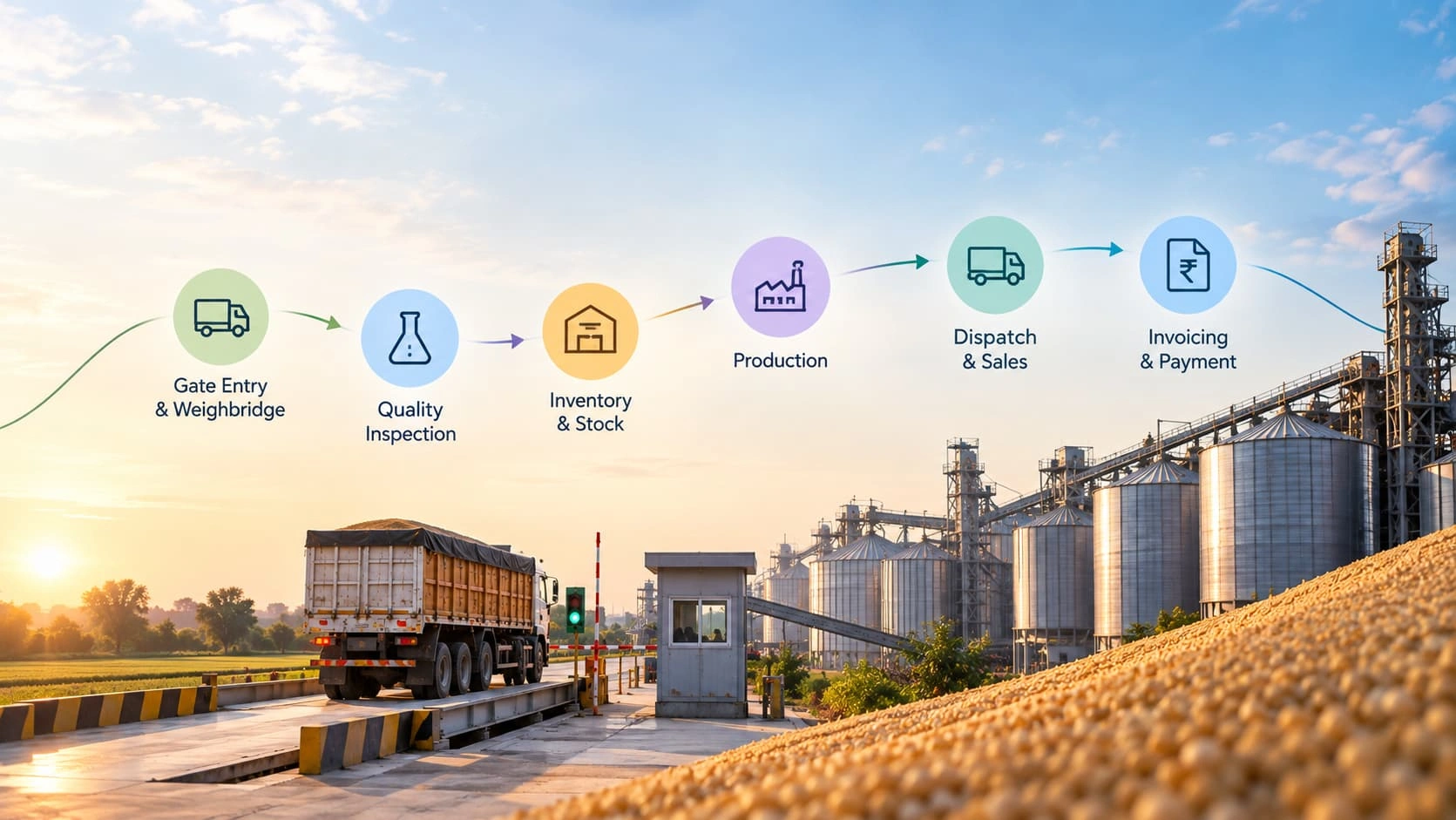
Why Agri-Commodity Manufacturing Needs Connected Operations
Agri-commodity manufacturing runs on scale and thin margins. A grain mill, an edible oil plant, a cattle feed unit or a spice processing facility deals with hundreds of vehicles, dozens of suppliers, and raw material that keeps changing, often within the same harvest season. The business itself is not hard to describe. Material comes in, it gets processed, finished goods go out. What makes it hard to run is the sheer number of transactions happening at once, each one carrying its own quantity, quality and financial outcome.
Agri-commodity manufacturing is full of transactions that look simple on their own.
A truck arrives with raw material. It gets weighed. The material is unloaded and tested. It moves into the plant. Finished goods are produced, sold and dispatched. Payments are made and accounts are updated.
But the challenge isn't any one of these activities.
The challenge is making sure they all tell the same story.
A supplier may say they sent you 30 tonnes. Your weighbridge may show something different. The lab may find that the quality isn't what was expected.
So, what do you actually pay?
The answer depends on information coming from procurement, the gate, weighbridge, warehouse, lab and accounts, and in many businesses these pieces still move separately before someone brings them together.
We recently worked with a large agri-food manufacturer to connect everything from a vehicle arriving at the plant to procurement, quality, stock and financial records moving forward together.
The goal was not simply to implement more software.
It was to make sure that as something happens on the ground, the system knows about it.
The Problem Is Usually Between the Departments
Most businesses already have systems for the major functions.
There may be a purchase order. A gate register. A weighbridge system. A lab process. Stock records. Sales invoices. Accounting software.
The issue often appears in between.
A vehicle has entered but hasn't been unloaded yet. Has someone noticed?
The truck has been weighed, but the quantity is different from what was expected. Who needs to act on it?
The material has been received, but quality inspection is still pending. Can the next step move ahead?
The lab has completed its inspection. Has the deduction been reflected in the purchase?
These are not unusual exceptions. They are part of everyday operations.
But when every stage is managed separately, people spend time chasing updates and reconstructing what already happened.
A connected operation changes that. Instead of asking different departments for the status of a transaction, the transaction itself carries its status forward.
Control Starts Before the Material Reaches the Store
For an agri-commodity manufacturer, the transaction often starts at the gate. A vehicle arrives, gets identified and linked to the relevant purchase or sales transaction, goes for weighment, and then waits for unloading, quality inspection or the next step.
At every stage, there should be visibility into where the vehicle or material is and what is still pending. This matters most when plants handle a large number of vehicles every day.
A vehicle that has been weighed but hasn't moved forward should not sit unnoticed in a register. The system should show that something is waiting.
The same applies to weighment. Any difference between what was expected and what was actually received should be visible the moment the vehicle is weighed, not discovered later when someone compares paperwork.
You are no longer piecing together what happened after the fact. The story is already being built as the transaction moves.
In Agri-Commodity Procurement, Quality Is Part of the Transaction
Quantity alone does not determine the value of raw material. Moisture, protein, fibre, foreign matter and other quality parameters affect the final settlement just as much.
This is where disconnected processes often create another problem.
The lab may complete the inspection, but the quality result sits separately from procurement. Someone then has to interpret the result, apply the relevant deduction and update the financial side of the transaction. That creates room for delays and inconsistencies.
A connected process works differently. The lab records the quality readings in the system. The applicable deduction rules are applied automatically. The result becomes part of the same purchase transaction.
Procurement, operations and finance are no longer working from three different versions of the same information. They are working from the same transaction.
That also makes the process easier to explain later.
What was ordered? What actually arrived? What quality was received? What is the final amount payable?
The answers are connected.
Operations Should Not Depend on Someone Updating the System Later
This is one of the biggest differences between simply using software and running connected operations.
In many plants, the physical activity happens first. Material is unloaded, moved, consumed in production, turned into finished goods. And later, someone updates the system.
The problem is that the system is always behind the actual operation. For process manufacturers, this matters even more, because material is constantly changing form and location.
Every one of these movements tells part of the story of the material. When those movements are connected to the actual operational transaction, stock becomes easier to trust. You are not waiting for the end of the day to find out what happened, where it moved, what was consumed and what was produced.
The goal is not to ask people to create more entries. The goal is to reduce the gap between what happened on the plant floor and what the system shows.
The Same Principle Applies When Goods Leave the Plant
The outbound process has its own set of questions.
Has the dealer exceeded their credit limit? What quantity has actually been loaded? Does the weighbridge reading match the expected dispatch? Are all the required documents in place before the vehicle leaves?
These questions involve sales, warehouse, dispatch and finance. Again, the challenge is not whether each department can do its own job. It is whether the transaction remains connected as it moves between them.
When credit, sales orders, loading, weighment and invoicing are part of one connected flow, the business does not have to reconcile the story after the truck has left. What was ordered, loaded and billed should already agree.
This matters even more in multi-plant businesses, where manual coordination becomes nearly impossible.
Finance Should Follow Operations, Not Recreate Them
Finance is often where disconnected operations finally become visible. Someone needs to piece together what was received, the quantity difference, the deductions applied and any additional costs, before accounting entries can even be created.
But ideally, finance should not have to recreate a transaction that operations has already completed. As the transaction moves forward, its financial impact should move with it: what was received affects inventory and payables, quality deductions affect value, related charges get absorbed into the transaction, and sales affect receivables and revenue.
The important point is not that every accounting entry is automated. It is that the accounting reflects what actually happened in the business.
The same principle applies to compliance. GST, TDS, invoicing and transport documentation should increasingly follow from the transactions already happening in the business, not from a separate exercise in collecting and preparing information.
When the underlying transaction is right, everything built on top of it becomes easier to trust.
Visibility Is Useful. Proactive Visibility Is Better.
Once operations are connected, the system can begin to highlight things that need attention.
A vehicle has been weighed but hasn't progressed. A quality inspection is still pending. The quantity received is outside the expected tolerance. A quality deduction looks unusual.
These are the moments when management can act, rather than discovering the same issues later during reconciliation, review meetings or audits, by which time the transaction is already complete.
Over time, the same information also provides useful business insight. Which suppliers consistently deliver better quality? Which quality parameters are causing the most deductions? Where are quantity differences occurring most frequently? Which part of the process regularly gets delayed?
These are not just reports. They are insights created from the same transactions the business is already running.
Connected Operations Are About More Than ERP
When people talk about ERP, the conversation often starts with modules: procurement, inventory, manufacturing, sales, accounts.
But an agri-commodity business does not operate in modules. Material moves. Vehicles move. Information moves. Money moves. The system needs to follow all of them.
A purchase order should not become disconnected when the truck reaches the gate. Weighment should not become a separate piece of information. Quality should not sit in a lab report waiting to be applied. Stock should not depend on someone remembering to update it later. Finance should not have to rebuild the story at the end of the process.
The information should move with the transaction.
The Real Opportunity for Agri-Commodity Manufacturers
As agri-commodity manufacturing businesses grow, complexity grows with them. More plants mean more locations. More suppliers mean more transactions. More vehicles mean more movement.
The answer is not necessarily more people checking more reports. It is designing operations so that each step naturally feeds the next.
What happens on the ground should already be visible in the system. And by the time management needs to ask what happened, the business should not be creating the story from scratch.
The story should already be there.
Frequently Asked Questions
Why do agri-commodity manufacturers need connected operations?
Because a single transaction, like one truckload of material, touches procurement, the gate, the weighbridge, the lab, the warehouse and accounts. If each of these tracks its own version of events, the business spends its time reconciling instead of deciding. Connected operations mean the transaction carries its status forward automatically, so nobody has to chase five departments to understand one truck.
How can manufacturers connect weighbridge and procurement?
The weighbridge reading should update the same purchase transaction the vehicle is linked to, not sit in a separate register that someone compares against the purchase order later. When a quantity difference shows up, it should be visible the moment the vehicle is weighed, so procurement can act on it immediately instead of discovering it during reconciliation.
Why should quality affect the purchase transaction directly?
Because for most agri-commodities, moisture, protein, fibre and similar parameters change what the material is actually worth, not just its quantity. When the lab result feeds directly into the purchase transaction with the applicable deduction, procurement, operations and finance are all working from the same number instead of three different interpretations of the same delivery.
How can manufacturers improve plant and inventory visibility?
By connecting stock movement to the operational transaction as it happens, rather than relying on someone to update the system after the fact. When material entering, moving and being consumed in production is captured as it occurs, stock reflects the plant floor in real time instead of catching up to it at the end of the day.
Why should finance be connected to operations instead of working separately?
Because finance should not have to rebuild a transaction that operations has already completed. When receipts, quality deductions and charges flow directly into the financial record, accounting reflects what actually happened in the business, and compliance work like GST and TDS becomes a byproduct of real transactions rather than a separate reconciliation exercise.
Related content

Auriga: Leveling Up for Enterprise Growth!
Auriga’s journey began in 2010 crafting products for India’s [...]