- Artificial Intelligence
How AI Is Changing Customer Support for Omnichannel Retail Brands in India
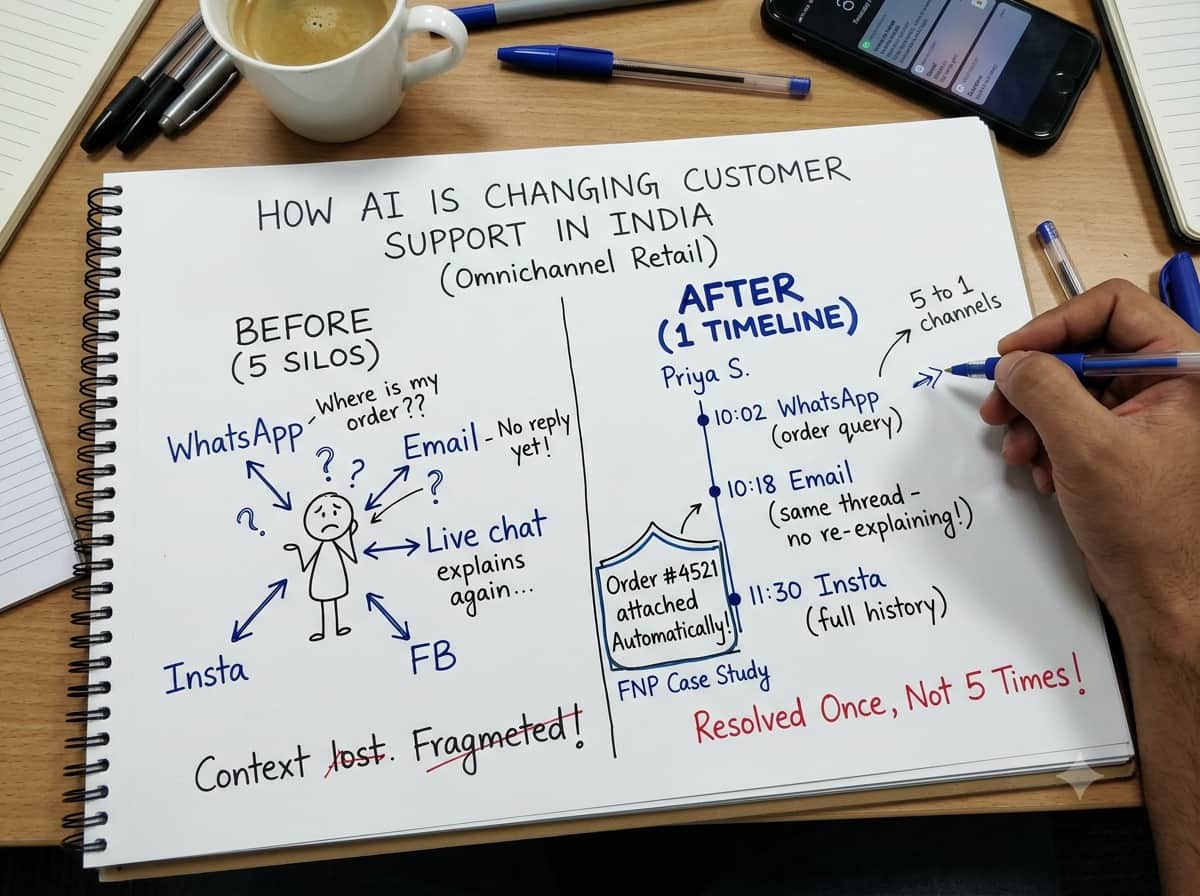
How AI Is Changing Customer Support for Omnichannel Retail Brands in India
Five channels. One customer. And nobody who can see the whole conversation.
AI customer support in omnichannel retail is not about closing tickets faster. It is about fixing a structural gap most dashboards never surface: the customer who repeats their problem on every channel switch, and the agent who rebuilds context that should have travelled with them. Here is what broke at Ferns N Petals, India's largest gifting brand, and what fixed it.
The same conversation, scattered across five channels, becomes one timeline that travels with the customer. This is the whole idea in one picture.
THE 60-SECOND VERSION
- The real cost is invisible on dashboards: agents juggling five tools, customers repeating themselves on every switch.
- Unified context comes before unified AI. One timeline per customer is the foundation everything sits on.
- Not every query deserves the same path. A delivery-time question and a failed anniversary gift are not equal.
- In retail, support is a revenue function. Resolution speed maps directly to repeat purchase rate.
- This ran at scale across 400 stores and 100 countries. The full case study is linked below.
Where omnichannel customer support breaks at scale
Most retail support metrics measure the wrong layer. They count tickets, response times and satisfaction scores. What they never capture is the friction between channels, which is exactly where the cost lives.
Picture a single complaint as it actually unfolds. The gaps between these messages are the whole problem:
Every repeat explanation erodes trust. Every channel switch adds handling time. And three problems compound quietly underneath, none of which shows up cleanly on a CSAT report: fragmented customer view, agents switching between five tools per shift, and franchise stores that are invisible to the central team.
Why omnichannel retail support in India is harder
The omnichannel problem is universal, but four things make it more acute in India, and they shape how the solution has to be built.
Customers move channels mid-journey
One complaint spans WhatsApp, Instagram, email and a call. Treat these as separate cases and you lose the thread immediately.
WhatsApp is the default, not an add-on
It is the primary way most customers expect to reach a brand. Treating it as secondary is misaligned with real behaviour.
Occasions are time-critical
Gifting and festival deliveries have hard deadlines. A slow resolution on Diwali or Valentine's Day is a missed occasion, not a service dip.
Franchise spread creates blind spots
National coverage through franchises means local fulfilment issues must be visible centrally, or time-sensitive orders stall.
Unified AI inbox: the three components that fixed it at Ferns N Petals
Ferns N Petals is India's largest omnichannel gifting brand, founded in 1994, with 400+ stores, delivery across 100+ countries, and 99% Indian PIN code coverage. It replaced a five-channel support stack with CygnusAlpha's unified AI inbox. The solution has three connected parts.
Cygnus Reach: one workspace for every channel
All five channels flow into a single interface. Every customer has one unified timeline, with order details and delivery status pulled in automatically.
- Single customer timeline across all channels, in one chronological view.
- Order context attached automatically so agents never ask for the order ID again.
- Internal notes and canned replies keep collaboration in the thread, no tool switching.
- WhatsApp 24-hour window compliance handled natively inside the workflow.
WhatsApp self-service: routine queries without an agent
Most queries at a gifting brand are transactional: order status, delivery time, ticket creation. A self-service bot on the verified WhatsApp number handles these directly, identifying customers by their registered phone number with no OTP friction.
- Track orders with live status and timelines, no queue.
- View recent purchases inside the chat, identified by phone number.
- Raise a ticket in under 30 seconds, routed to the right team.
- No OTP or login so the friction that causes drop-off disappears.
AI-human routing: the right response every time
A question about delivery time should never use the same resource as a failed anniversary delivery. The routing engine reads intent, complexity and emotional weight, and sends each message to the right place automatically.
Automation
Repetitive transactional queries such as order status and return policy, handled with no agent involvement.
AI-assisted agent
Moderate queries like address changes or partial refunds go to an agent with AI-suggested replies ready.
Senior human
Escalated, emotional or high-value cases go directly to experienced staff.
AI customer support metrics that actually matter
CSAT is a lagging, noisy signal. These are the measures that connect support directly to the business, and the mechanism by which a unified AI inbox moves each one.
| Metric | What moves it |
|---|---|
| First response time | Agents pick up conversations already informed by unified context, removing the "send me your order ID" delay |
| Average handling time | Eliminating tool switching removes minutes from every conversation |
| Cost per contact | Automation absorbs routine volume, so agent hours go only to complex cases |
| Resolved by automation | WhatsApp self-service handles transactional queries entirely without a human |
| Repeat purchase rate | Fast, consistent resolution on the preferred channel makes customers significantly more likely to reorder |
Support at retail scale has a direct line to revenue. A slow resolution during peak gifting season is not an operational miss. It is a lost repeat order.
Unified AI inbox vs standard helpdesk
Standard helpdesk
- Built for ticket management
- Channels bolted on as separate inboxes
- Order data looked up manually elsewhere
- Routing by query category only
- WhatsApp handled as an afterthought
Unified AI inbox
- Built for omnichannel retail operations
- All channels in one shared timeline
- Order context surfaced in every conversation
- Routing factors in emotional weight
- Native WhatsApp compliance and self-service
Is a unified AI inbox right for your retail brand?
A strong fit if
You run support across three or more channels, customers move between them mid-journey, your order volume is time-sensitive, and agents switch tools to piece together context.
Probably premature if
You operate on a single channel, volume is low enough for a small team to handle comfortably, or your product has no time-critical fulfilment pressure.
Frequently asked questions about AI customer support
What is a unified AI inbox for customer support?
A unified AI inbox consolidates conversations from every channel such as WhatsApp, email, live chat, Instagram and Facebook into one agent workspace. Each customer has a single timeline regardless of channel. AI classifies incoming queries, pulls in order context, and routes complex cases to the right human agent, so agents spend time resolving issues rather than switching tools.
Why does omnichannel support matter for retail brands in India?
Indian customers routinely move between WhatsApp, Instagram, email and phone within a single journey. When each channel is a separate silo the customer repeats their issue at every touchpoint and satisfaction drops quickly. Omnichannel support maintains context across channels, reduces resolution time, and directly increases repeat purchases, which for gifting brands is the primary revenue driver.
How does AI-human hybrid routing work in retail support?
It classifies every incoming query by intent, complexity and emotional weight, then sends it to the right path. Simple transactional questions go to automation. Moderate queries go to an AI-assisted agent with suggested responses ready. Emotionally charged or high-stakes cases such as failed deliveries or damaged gifts go directly to senior agents, so the level of care matches the query.
How does a unified inbox reduce customer support costs?
Cost per contact drops three ways. Automation absorbs routine query volume without agent involvement. Eliminating tool switching reduces average handling time. Intelligent routing reserves expensive senior-agent time for complex cases only. Together these cut both the volume needing human handling and the time each interaction takes.
What metrics matter most for AI-driven retail customer support?
Beyond CSAT: first response time, average handling time, cost per contact, percentage of queries resolved by automation, and repeat purchase rate. For gifting and recurring-occasion retail, repeat purchase rate is often the single most important measure, because a well-resolved customer returns for the next occasion.
How is a unified AI inbox different from a standard helpdesk?
Standard helpdesks are built for ticket management. A unified AI inbox is built for omnichannel operations, with native WhatsApp compliance, order-system integration that surfaces context inside every conversation, intent-based routing that factors in emotional weight, and self-service automation for the channels customers actually use, without app downloads or logins.
Running support across multiple channels?
If your agents switch tools to piece together context, or your WhatsApp volume is handled manually, Auriga IT can consolidate and automate it. See how it worked for Ferns N Petals across 400 stores and 100 countries.
Related content

Auriga: Leveling Up for Enterprise Growth!
Auriga’s journey began in 2010 crafting products for India’s [...]