Why the AI Industry Is Talking About Jensen Huang’s AGI Prediction?
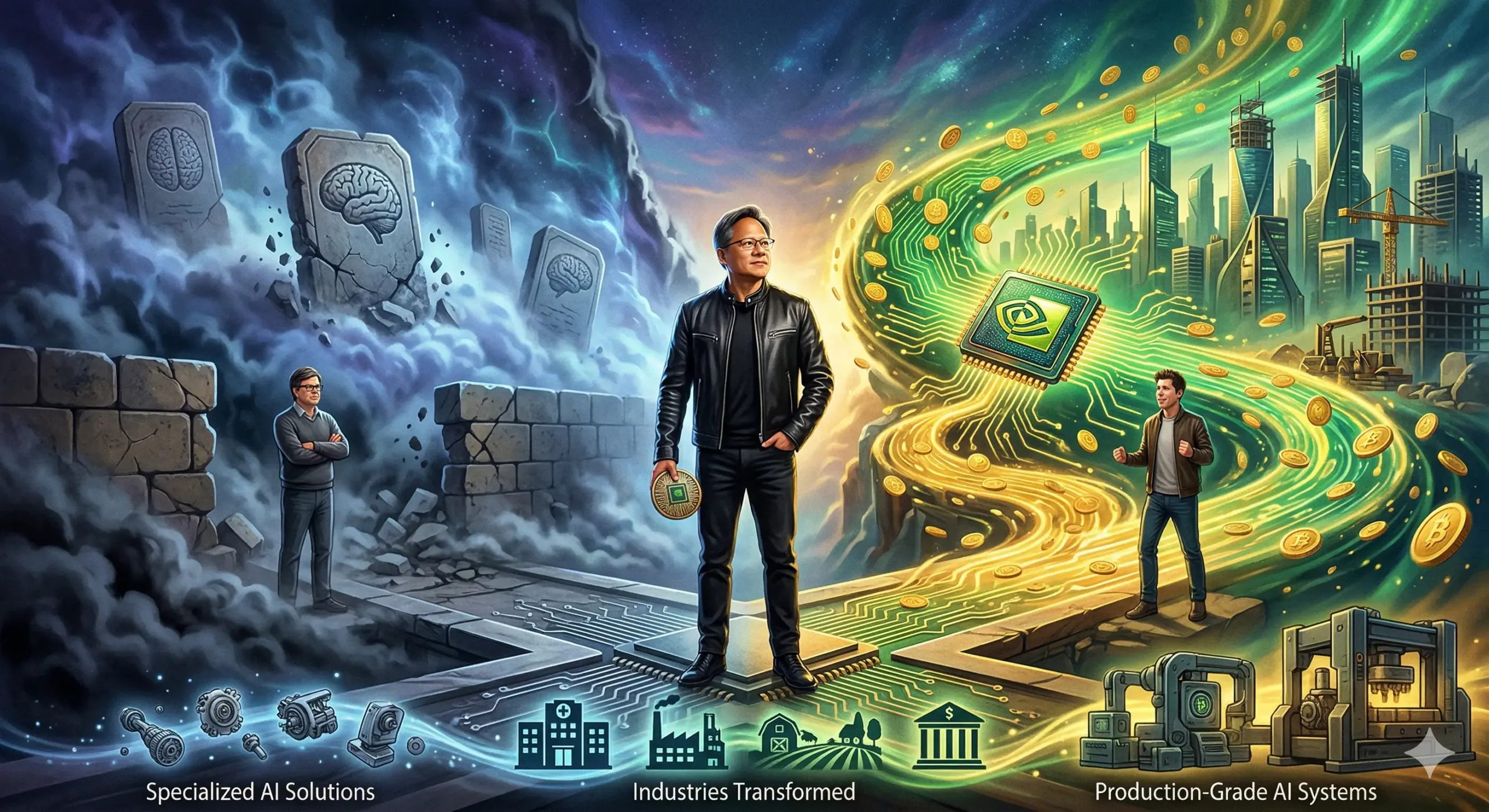
Why the AI Industry Is Talking About Jensen Huang’s AGI Prediction?
The most powerful claim in AI - unpacked, debated, and made actionable for your business.
- Jensen Huang publicly stated "I think we've achieved AGI" during the Lex Fridman Podcast released on 22 March 2026, making him one of the most prominent tech leaders to make this claim.
- Huang defines AGI through economic capability, arguing that AI systems can already autonomously create billion-dollar businesses, even if only temporarily.
- He immediately qualified the statement, acknowledging that AI cannot yet build or sustain a complex institution like NVIDIA over decades.
- NVIDIA's dominance makes this claim significant: the company holds roughly 80 to 90 percent of the AI accelerator market and powers the vast majority of AI training worldwide.
- The tech industry remains deeply divided: Sam Altman says OpenAI has "basically built AGI," Elon Musk predicts AGI by 2026, while Yann LeCun calls general intelligence "complete BS."
- For businesses, the debate is secondary to action: regardless of whether this qualifies as AGI, today's AI systems are already capable of reshaping operations, products, and competitive advantage.
The Moment That Changed the AGI Conversation
The clip spread within hours. When the CEO of a company worth over four trillion dollars - a company whose chips power roughly 80 percent of all AI training on the planet - declares that AGI has arrived, the entire industry stops to listen.
But what Huang said next was just as important as the headline. He immediately qualified the claim. He noted that Fridman had said a billion-dollar company but had not specified for how long.
Huang suggested that an AI model could conceivably create a viral application, attract billions of users at fifty cents each, and generate massive revenue, even if the business collapsed shortly after. When Fridman asked whether AI agents could build something as enduring as NVIDIA itself, Huang was unequivocal: the probability was zero percent.
This is the nuance most headlines missed. Huang was not claiming that machines have achieved human-like consciousness. He was redefining AGI through a practical, output-driven lens - one that measures intelligence by economic impact rather than philosophical benchmarks.
What Is AGI? The Definitive Definition
Unlike narrow AI, which excels at specific tasks such as image recognition or language translation, AGI would demonstrate broad cognitive ability. There is no universally accepted definition, and that is precisely why the debate over Huang's claim is so heated.
OpenAI defines AGI as "a highly autonomous system that outperforms humans at most economically valuable work." Google DeepMind has proposed a framework with multiple levels of AGI, ranging from emerging to superhuman. Jensen Huang frames AGI as the ability for AI to autonomously generate significant economic value.
Narrow AI vs AGI vs ASI: A Comparison
| Narrow AI | AGI | ASI | |
|---|---|---|---|
| Definition | AI designed for a specific task or narrow set of tasks | AI with human-level ability across all cognitive domains | AI that surpasses all humans in every intellectual field |
| Example | ChatGPT, Google Translate, Siri | Hypothetical: AI that codes, diagnoses patients, and negotiates deals equally well | Hypothetical: AI making discoveries beyond human comprehension |
| Capability | Superhuman in narrow domains, limited outside them | Human-equivalent across all intellectual tasks | Exceeds all human intellectual capacity |
| Status (2026) | Widely deployed | Actively debated | Theoretical |
| Key Advocate | Universal consensus | Jensen Huang, partially Sam Altman | No serious researcher claims this |
What Jensen Huang Actually Said About AGI
Fridman defined the benchmark as an AI system that could start, grow, and run a successful technology company worth over one billion dollars. He asked Huang whether such a system was five, ten, or twenty years away.
Huang then provided context. He argued that it was "not out of the question" that an AI system could create a web service that attracted billions of users briefly and generated substantial revenue, even if the business collapsed shortly after.
Huang's AGI claim rests on three pillars:
First, AGI should be defined by what AI can produce in the real world, not by philosophical benchmarks about consciousness. Second, today's AI systems can already autonomously generate significant economic value. Third, achieving this does not mean AI can match humans at everything - sustained institutional management, physical-world understanding, and long-horizon strategy remain beyond current systems.
Is Your Business Ready for the AGI Era?
Why NVIDIA Is the Infrastructure Behind AGI
Every large language model - from GPT-4 to Gemini, Claude, and Grok - is trained on clusters of NVIDIA GPUs. The process involves feeding massive datasets through neural networks, adjusting billions of parameters through repeated computation. NVIDIA's GPUs are purpose-built for this work.
The company's data centre segment generated over $100 billion in fiscal year 2025 and is projected to exceed $130 billion in fiscal 2026. Its CUDA software ecosystem, developed over two decades, is deeply embedded in every major AI framework, creating switching costs that competitors have struggled to overcome.
How GPU Compute Powers AI: The Pipeline
When Huang says AGI has arrived, he is also making a statement about his own company's relevance. If AGI is here, demand for NVIDIA's high-end chips is not merely strong - it is structurally essential. Every company racing toward more capable AI needs more compute, and NVIDIA makes the compute.
The Evidence Supporting Huang's Claim
GPT-4, released in March 2023, demonstrated strong performance across mathematics, coding, and scientific reasoning. Google's Gemini matched or exceeded human expert performance on multiple academic benchmarks. AI agents now handle complex coding tasks, conduct deep research, and manage multi-step workflows autonomously.
In mid-2025, Sam Altman described agents performing "real cognitive work," noting that writing computer code would never be the same. By 2026, companies are deploying AI systems that conduct legal research, manage financial compliance, analyse medical imaging, and generate working software applications - often with minimal human oversight.
The ARC-AGI benchmark, designed specifically to test general reasoning ability rather than pattern matching, has seen rapid improvement from AI systems, though meaningful gaps remain compared to human performance.
The Debate: Who Agrees and Who Disagrees
Sam Altman, OpenAI CEO
Altman wrote in January 2025 that OpenAI was "confident we know how to build AGI." He later told Forbes that OpenAI had "basically built AGI, or very close to it," though he clarified this was meant in a "spiritual" sense. By mid-2025, he described AGI as "not a super useful term," arguing that progress should be measured in levels rather than as a binary declaration.
Yann LeCun, Turing Award Winner
LeCun represents the sharpest counterpoint. He has called general intelligence "complete BS" and argued that large language models are fundamentally incapable of human-level reasoning. He departed Meta in late 2025, launched AMI Labs with a reported 500-million-euro raise, and insists that "world models" - AI systems grounded in physical reality rather than text - are the actual path forward.
Demis Hassabis, Google DeepMind CEO
Hassabis publicly pushed back on LeCun, calling him "just plain incorrect." He argued that human brains are "extremely general" learning systems and that AI architectures are capable of similar generality. He has called for a United Nations-style body to oversee AGI development.
Elon Musk, xAI Founder
Musk has repeatedly predicted AGI by 2026 via xAI's Grok models, tying the timeline to massive GPU infrastructure buildouts. His xAI reportedly raises $20 to $30 billion per year. Critics note that Musk's AGI predictions consistently serve his fundraising needs and that his technology prediction track record is mixed at best.
AI Is Already Transforming Business. Here's Proof.
AI Traffic Management System for NHAI Expressways
Deployed an AI-powered computer vision system on India's national expressways, detecting wrong-way drivers, high-speed vehicles, and real-time incidents across 90,000 to 100,000 daily vehicles.
View Case Study →NHAI Toll Monitoring & Control Centre (TMCC)
Built a cloud-native AI and IoT platform giving NHAI centralised visibility across all toll plazas, with predictive models for equipment failure, revenue forecasting, and compliance reporting.
View Case Study →RecoBee - AI-Powered Content Recommendation App
Revamped an AI-powered entertainment app with personalised watchlist recommendations, behavioural analytics, monetisation models, and a community platform, driving major engagement growth.
View Case Study →AI-Powered CRM and Chatbot for TR Capital Financial Advisory
Integrated an OpenAI-powered chatbot into a custom CRM system, enabling human-like client interactions, automated ticket generation from WhatsApp, and real-time compliance analytics.
View Case Study →Build Your AI Advantage Before Your Competitors Do
What AGI Means for Businesses Right Now
AI detects tumours in imaging with specialist-level accuracy. Drug discovery timelines are compressing from years to days.
Algorithmic trading, fraud detection, and compliance automation are being accelerated by LLM-powered analysis.
Predictive maintenance reduces downtime. Computer vision inspects products at speeds humans cannot match.
AI coding assistants accelerate development by 30 to 55 percent. Entire applications are generated with AI involvement.
Personalised recommendations, dynamic pricing, and AI customer service are already standard in e-commerce.
Contract analysis and document review that took teams of lawyers weeks now takes AI systems hours.
What AGI Means for India and Emerging Markets
At the India AI Impact Summit 2026, Yann LeCun specifically highlighted that countries with large young populations - including India - are positioned to lead the next phase of AI innovation. India's National AI Mission and growing private-sector investment reinforce this trajectory.
The risks are equally real. Jobs in IT services, business process outsourcing, and routine knowledge work face significant disruption. The companies and professionals who adapt - by building AI-augmented capabilities rather than competing against AI - will thrive. Those who wait may find themselves displaced.
For Indian enterprises and global businesses operating in India, the strategic question is not whether AGI has arrived. It is whether your organisation is building the capabilities to compete in an AI-first world.
How Auriga IT Is Building with AI Today
While the AGI debate continues among researchers and CEOs, Auriga IT's focus is on what AI can do for businesses right now. The company has deployed AI-powered traffic systems processing 100,000 vehicles daily, built intelligent CRM systems with OpenAI-powered chatbots for financial services firms, and scaled AI personalisation platforms serving tens of thousands of users.
From intelligent automation and predictive analytics to AI-augmented digital products, Auriga IT's approach is grounded in real-world results - identifying high-impact use cases, building robust data foundations, and deploying models that deliver value from day one.
Whether the current generation of AI qualifies as AGI is a question for researchers. What matters for business leaders is that the tools available today are powerful enough to transform operations, customer experiences, and competitive positioning. Explore Auriga IT's Data and AI services to find out where AI creates the highest value in your context.
Frequently Asked Questions
What did Jensen Huang say about AGI?
NVIDIA CEO Jensen Huang stated "I think we've achieved AGI" on the Lex Fridman Podcast released on 22 March 2026. He defined AGI through the lens of economic output, arguing that AI systems can already autonomously create billion-dollar businesses. He qualified the statement by acknowledging that AI cannot yet build or sustain a complex institution like NVIDIA over decades.
Has AGI arrived in 2026?
As of 2026, there is no consensus that AGI has arrived. Jensen Huang and Sam Altman believe current systems meet certain definitions of AGI. However, researchers like Yann LeCun argue that today's large language models lack fundamental understanding of the physical world. The answer depends entirely on how AGI is defined.
What is the difference between AGI and AI?
AI refers broadly to any system that performs tasks typically requiring human intelligence. Most AI today is narrow AI, meaning systems designed for specific tasks like translation or image recognition. AGI refers to a system that can perform any intellectual task a human can, with flexible reasoning across all domains without task-specific programming.
Why does NVIDIA matter for AGI?
NVIDIA matters because its GPUs power the vast majority of AI training worldwide. The company holds roughly 80 to 90 percent of the AI accelerator market and its CUDA software ecosystem is the standard for AI development. Without NVIDIA's infrastructure, the large language models underpinning the AGI conversation could not be built at scale.
Which AI is closest to AGI right now?
No AI system has been universally recognised as achieving AGI. The leading frontier models - including OpenAI's GPT-4 and successors, Google DeepMind's Gemini, and Anthropic's Claude - demonstrate broad capabilities across reasoning, coding, and research. However, all still lack persistent memory, true physical-world understanding, and the ability to manage complex long-term tasks autonomously.
What will AGI mean for jobs?
AGI-level AI will transform rather than eliminate most jobs. Routine cognitive tasks face the highest automation risk. Roles requiring physical dexterity, emotional intelligence, and creative judgment are more resilient. Workers who effectively use AI tools will vastly outperform those who do not.
Who disagrees that AGI has arrived?
Yann LeCun, Turing Award winner and former Meta chief AI scientist, is the most vocal critic, calling general intelligence "complete BS." Microsoft CEO Satya Nadella said the industry is "not anywhere close." Former Tesla AI chief Andrej Karpathy estimated AGI is still about ten years away. Many academic researchers share similar scepticism.
How will AGI affect businesses in India?
AGI-level AI will create enormous opportunities for Indian businesses in AI-powered services, software development, and data analytics. India's technically skilled workforce and digital infrastructure position it well. However, traditional IT services and BPO roles face disruption. Companies that invest in AI augmentation and upskilling will gain decisive competitive advantage.
Conclusion
Jensen Huang's declaration that AGI has arrived is less a scientific verdict and more a strategic signal. It tells us that the CEO of the world's most valuable semiconductor company - the man whose hardware powers nearly all AI training - believes current AI systems have crossed a meaningful threshold.
Whether you agree with his definition or not, the underlying reality is undeniable. AI systems today can write software, diagnose diseases, conduct research, manage complex workflows, and generate significant economic value, autonomously.
For business leaders, the right response is not to wait for researchers to settle the definition. It is to act. The organisations that build AI capabilities now - that embed intelligence into their products, operations, and strategy - will define the next decade of competition.
Ready to Build with AI?
Related content

Auriga: Leveling Up for Enterprise Growth!
Auriga’s journey began in 2010 crafting products for India’s [...]