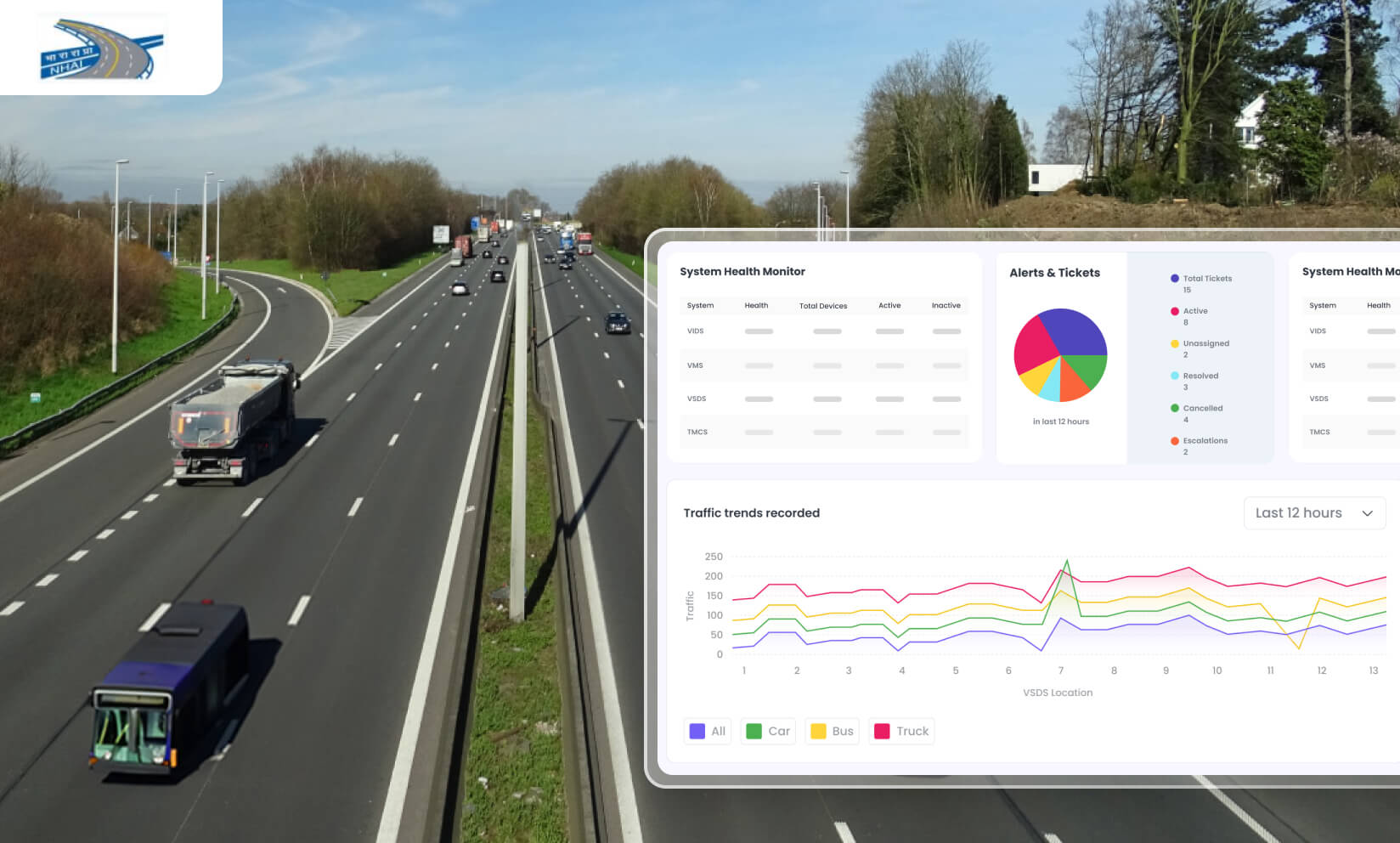
Real-Time Highway Intelligence for India’s National Expressway Network
Case Study - AI and Data Engineering - Government Infrastructure
India's national highway network was growing faster than human operators could monitor it. Incidents went undetected for minutes. Response teams had no live picture of what was happening across thousands of kilometres. The answer was a 13-module AI platform that put real-time intelligence at the centre of every highway operation.
50,000+ km HighwaysComputer Vision AI13 ATMS ModulesIoT and Sensor IntegrationReal-Time Incident Detection
Published: 20 December 2023 - Updated: 15 May 2026 - By Gaurav Sharma - AI and Data Engineering - Government Infrastructure - India
50,000+
km of National Highways
13
ATMS Modules Deployed
8 min+
Faster Incident Reporting
AI Vision
Incident Detection Engine
Live
Multi-Source Data Integration
Feb 2023
PM-Inaugurated Deployment
01 - About NHAI
Managing 50,000 Kilometres With Human Eyes Alone Was No Longer Possible
The National Highways Authority of India (NHAI) is an autonomous government agency established in 1995, responsible for managing over 50,000 km of national highways. As expressway networks expanded and traffic volumes grew, the limitations of manual monitoring became a direct safety risk - incidents went undetected, response times stretched, and operators had no unified operational view.
National Highways Authority of India
Government Infrastructure - New Delhi, India
When a vehicle drives the wrong way on a six-lane expressway at 2am, a human operator monitoring 200 camera feeds cannot guarantee they will see it. When a stationary vehicle sits in a live lane after a breakdown, the window before a secondary collision is measured in seconds. NHAI's challenge was not a lack of cameras or sensors. It was the absence of a system that could process what they saw, recognise what mattered, and alert the right people fast enough to make a difference.
02 - The Problem
Four Gaps That Made India's Highways Less Safe Than They Could Be
NHAI faced four compounding operational gaps: no automated detection of safety incidents across expressway CCTV feeds, no unified platform to process data from cameras, sensors, and traffic systems simultaneously, no mechanism to alert authorities within seconds of an incident, and response times to accidents and wrong-way driving that cost lives.
Before
Operators manually scan hundreds of feeds. Wrong-way vehicles and obstructions missed until reported by other drivers.
Camera data, sensor readings, and traffic logs exist in separate silos. No single command view of conditions.
Incident reports filed manually. Response teams dispatched without precise location or incident type.
Average incident reporting time over 8 minutes. Secondary collisions at incident sites remain a major fatality cause.
After Auriga IT
AI computer vision monitors every feed simultaneously. Wrong-way driving and obstructions detected in seconds.
All sources - CCTV, IoT, ANPR, radar, traffic systems - unified into a single command centre dashboard.
Automated alerts sent with incident type, location, severity, and live camera link within seconds of detection.
Incident reporting time reduced by over 8 minutes. Response teams dispatch with full context before reaching the scene.
01
No Automated Incident Detection
Human operators could not reliably monitor hundreds of simultaneous feeds. Safety incidents went undetected until reported by other road users - often too late.
02
Fragmented Data Sources
CCTV, IoT sensors, radar, ANPR, and traffic platforms generated data independently. No unified system to create a single operational picture.
03
Slow Emergency Response
Without automated detection and alerting, response times to accidents and wrong-way drivers were too slow. Every minute of delay compounds the risk.
04
No Scalable Monitoring Layer
Manual systems could not scale with network expansion. Without an automated intelligence layer, the monitoring gap would only widen as more expressways came online.
03 - What Was Built
13 Modules. One Unified Highway Intelligence Platform.
Auriga IT built a complete Advanced Traffic Management System comprising 13 integrated modules - spanning AI computer vision incident detection, vehicle speed monitoring, real-time traffic dashboards, variable messaging, facility management, event tracking, automatic vehicle classification, travel time measurement, driver assistance, emergency calling, and video management. All 13 modules deployed on the Delhi-Mumbai Expressway and inaugurated by the Prime Minister in February 2023.
1
Video Incident Detection System - AI Watching Every Camera at Once
The VIDS module uses AI-powered computer vision to monitor all CCTV feeds simultaneously. It detects wrong-way driving, stationary vehicles, high-speed violations, roadblocks, and congestion automatically - without a human operator needing to spot the incident first. When an event is detected, an alert fires instantly with incident type, severity, camera location, and a live feed link.
Wrong-Way Detection
Vehicles against traffic flow identified and flagged within seconds of entry
Stationary Vehicle Alert
Stopped vehicles in live lanes detected before secondary incidents occur
Congestion Detection
Traffic slowdowns identified by comparing real-time vehicle speed differentials
Instant Alert Generation
Command centre notified with incident type, location, and live camera feed
atms.nhai.gov.in / command / vids-dashboard
Live
Vehicle Incident Detection System - 10/13 VIDS active, 20,000 vehicles tracked, live incident alert feed
2
Vehicle Speed Detection System
Identifies and records speeding vehicles using radar and camera data. Alerts generated for vehicles exceeding safe thresholds, supporting both enforcement and hazard prevention across the expressway.
atms.nhai.gov.in / command / vsds
Vehicle Speed Detection System - Real-time speed monitoring and threshold alerting
3
Traffic Monitor Camera System
Provides real-time visibility through multiple simultaneous camera feeds. Command centre operators monitor and control expressway traffic from a unified multi-feed interface without switching between separate systems.
atms.nhai.gov.in / command / traffic-monitor
Traffic Monitor Camera System - Unified multi-feed view for command centre operators
4
Highway Traffic Monitoring System - One Map for the Entire Expressway
Command centre executives get a bird's-eye view of the full highway through a marker-based map interface. Every camera, sensor, and VIDS device is plotted with live status indicators. Event markers show active incidents in real time. Device health alerts fire immediately when a system goes offline or degrades.
atms.nhai.gov.in / command / highway-map
Live
Highway Traffic Monitoring System - Complete expressway map with real-time device health and incident markers
5
Variable Messaging System
Command centre personnel broadcast traffic alerts, weather warnings, and construction updates to roadside digital signboards across the expressway by connecting directly to each board's IP address. Road users receive advance warning before reaching hazardous conditions.
atms.nhai.gov.in / command / vms
Variable Messaging System - Signboard map and real-time message broadcast interface
8
Automatic Traffic Count and Classification
Counts and classifies every vehicle type automatically using ANPR and VIDS camera data. All records flow to the ATMS Control Centre for monitoring and traffic pattern analysis across the expressway.
atms.nhai.gov.in / command / atcc
Automatic Traffic Count and Classification - Vehicle type distribution and real-time count monitoring
12
Emergency Calling Box
Roadside emergency boxes connect directly to the command centre. Calls processed via server and SDK for swift response, integrating ECB units, telecom providers, and the national 1033 emergency service into one unified response channel.
The remaining six modules complete the full ATMS platform:
6
Facility Management System
Real-time health monitoring and remote command execution for all connected devices - cameras, VIDS units, radar systems - from a single control panel at the command centre.
7
Event Management Module
Traffic jams detected automatically by comparing real-time vehicle speeds. Operators verify and register events through patrol vehicles, VIDS, ANPR, and VSDS confirmation before escalation.
9
Travel Time Measurement System
Measures travel times and speeds between expressway sections using ANPR cameras. Vehicle plates time-stamped at entry and exit points for accurate speed and journey time calculation.
10
Report Generation Module
Generates five key reports automatically - Alerts, ATCC vehicle data, Events, Device Malfunction, and IP Address Master - giving management a complete operational audit trail.
11
Advanced Driver Assistance System
Installed on patrol vehicle tablets. Detects nearby obstacles and driver errors in real time with dedicated screens for camera feeds, maps, alerts, and emergency ticketing.
13
Video Management System
Live and recorded video access from all connected highway cameras. AI event recognition improves surveillance coverage and reduces manual review time across the network.
04 - Technology Stack
What Powers the Platform
The NHAI ATMS platform is built on a computer vision and AI layer using YOLO-based models for real-time incident detection, integrated with IoT sensor networks, ANPR cameras, radar systems, and a unified command dashboard that processes all data sources into a single operational interface.
Layer
Technology
What It Does
Vision AI
YOLO Computer Vision
Real-time detection of wrong-way driving, speeding, stationary vehicles, and congestion across all CCTV feeds simultaneously
Cameras
ANPR and VIDS
Automatic number plate recognition and video incident detection providing the primary data feed for speed, classification, and incident modules
Sensors
IoT and Radar
Speed measurement, vehicle presence detection, and environmental monitoring feeding real-time data into the unified command platform
Pipelines
Real-Time Integration
Unified ingestion layer processing simultaneous feeds from cameras, sensors, radar, and traffic management systems into one operational view
Dashboard
Command Centre Platform
Centralised map-based interface giving executives live visibility of all devices, incidents, and expressway conditions across the network
Messaging
Variable Messaging System
IP-based direct connection to roadside signboards enabling real-time alerts and advisories to road users within seconds
Emergency
ECB and 1033 Integration
Roadside emergency boxes linked to command centre, integrating telecom providers and the national 1033 emergency response service
05 - Business Impact
What Changed on India's Highways
The ATMS deployment delivered four measurable outcomes: incident reporting times reduced by over 8 minutes, smoother traffic flow through real-time coordination and variable messaging, improved road safety through live intelligence that gives authorities time to act before situations escalate, and a scalable architecture ready for nationwide rollout.
On a high-speed expressway, 8 minutes is not an administrative metric. It is the difference between a patrol vehicle reaching an incident before a secondary collision and arriving after one. This system changes the safety equation at national scale.
8 Minutes Faster Incident Reporting
Automated detection and instant alerting cut reporting time by over 480 seconds versus manual operator monitoring
Smoother Traffic Flow
Real-time congestion detection, variable messaging, and coordinated incident response reduce delays for all road users
Safer Roads Through Live Data
Authorities manage conditions with real-time intelligence rather than delayed reports - enabling faster, better-informed decisions
Nationwide Scalability
The ATMS architecture is designed for replication across India's full national highway network - every new expressway a candidate
PM-Inaugurated on Day One
All 13 modules deployed and operational for inauguration by Prime Minister Narendra Modi on 12 February 2023
Zero-Gap Surveillance
AI monitoring eliminates the human attention gap across hundreds of simultaneous feeds - every camera watched, every second
06 - Common Questions
Questions About AI Traffic Management and Highway Intelligence
What is an Advanced Traffic Management System for national highways?
+
An ATMS integrates AI computer vision, IoT sensors, ANPR cameras, radar, and traffic management tools into a single command-centre interface. It enables real-time monitoring of expressway conditions, automatic incident detection, instant alerting to response teams, and data-driven traffic coordination - replacing manual operator monitoring with an always-on automated intelligence layer that scales across any network size.
How does AI detect traffic incidents on highways automatically?
+
AI incident detection uses computer vision models trained on highway footage to analyse all video feeds simultaneously in real time. The system recognises patterns for wrong-way driving, stationary vehicles in live lanes, speed differentials indicating congestion, and poor visibility conditions. When a pattern is matched, an alert is generated automatically with incident type, location, severity, and a live camera link - without a human operator needing to see the event first.
What is a Variable Messaging System on expressways?
+
A Variable Messaging System allows command centre personnel to send real-time information to roadside digital signboards by connecting directly to each board's IP address. Operators broadcast traffic alerts, accident warnings, construction notices, and speed restrictions within seconds - giving road users advance warning before they reach hazardous conditions ahead.
How does ANPR integrate with highway traffic management?
+
ANPR cameras capture vehicle images at fixed expressway points, extracting plate numbers, timestamps, and location data. This feeds vehicle classification for the ATCC count system, travel time calculation by comparing entry and exit timestamps, and incident verification when cross-referenced with VIDS and radar data.
Can this system scale to more highways across India?
+
Yes. The NHAI ATMS was architected for nationwide replication from the start. The modular design means individual components can deploy on new expressways as infrastructure comes online without rebuilding the core platform. The command interface handles multiple expressways simultaneously and data pipelines scale horizontally as device counts increase.
What was Auriga IT's role in the NHAI ATMS project?
+
Auriga IT designed, built, and deployed all 13 modules of the Advanced Traffic Management System for NHAI's Delhi-Mumbai Expressway - including AI computer vision, real-time data integration, command dashboard, variable messaging, facility management, emergency calling integration, and automated reporting - delivered for the PM inauguration on 12 February 2023.
Building Intelligence Into Infrastructure?
If you manage large-scale physical infrastructure generating real-time data from cameras, sensors, or IoT devices - and need a platform that turns that data into operational decisions - this is a problem Auriga IT has solved at national scale.