- Digital Products & Software
ERPNext in 2026: The Definitive Guide to Open-Source ERP for Growing Businesses
ERPNext in 2026: The Definitive Guide to Open-Source ERP for Growing Businesses
Open-Source ERP · ERPNext v16 · 2026 Business Guide
ERPNext in 2026: The Definitive Guide to Open-Source ERP for Growing Businesses
Quick answer: ERPNext is a 100% open-source, full-stack ERP platform built on the Frappe Framework. It unifies accounting, inventory, manufacturing, HR, CRM, and project management with zero per-user licensing fees. Version 16, released January 2026, introduced Frappe Caffeine for faster performance, a redesigned UI, Phantom BOMs, and enhanced payroll. Typical implementations take 3–6 months and cost a fraction of SAP or Oracle.
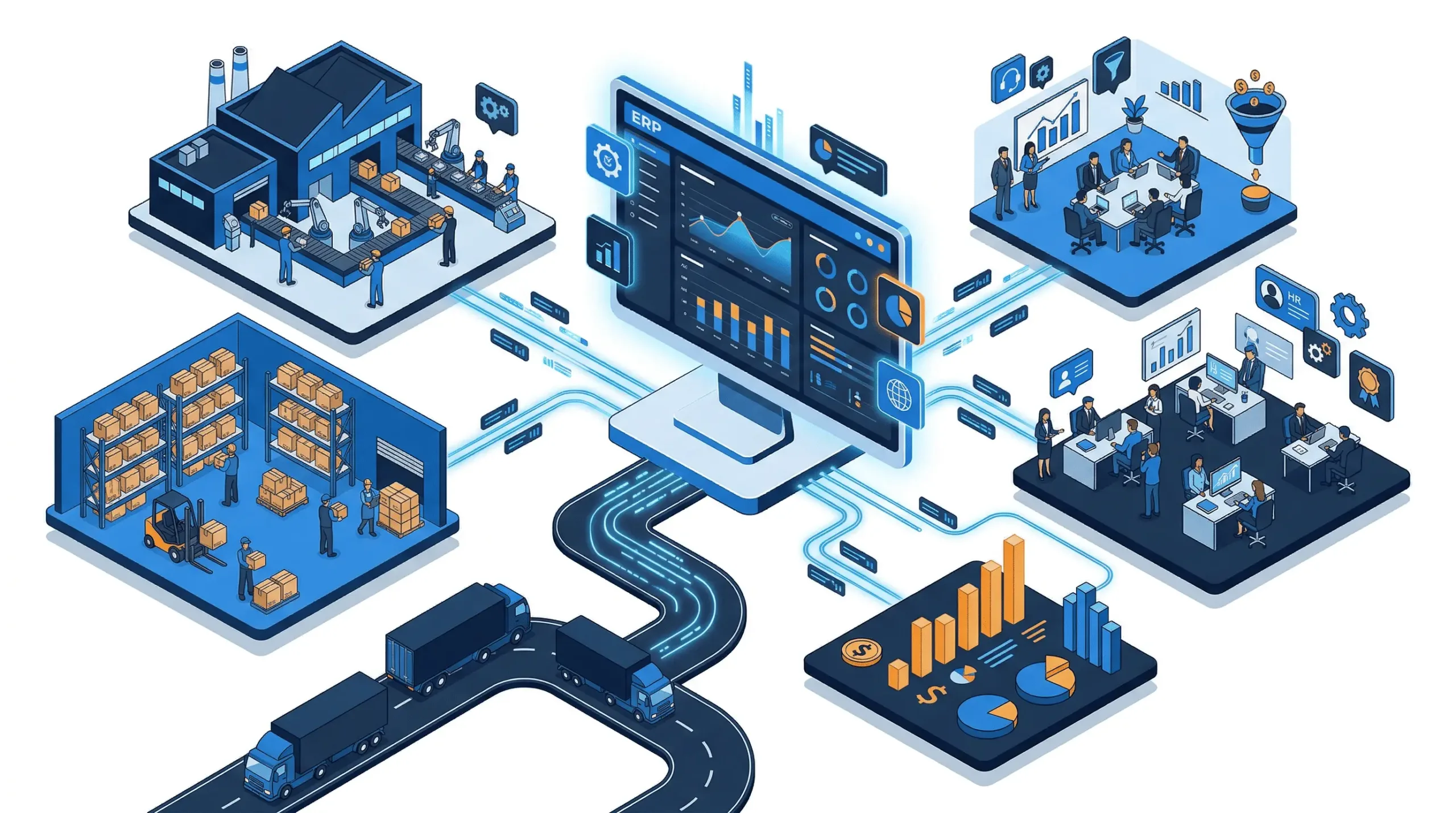
ERPNext has evolved into one of the most practical ERP choices for growing businesses. In 2026, rising proprietary ERP costs, stronger open-source maturity, and ERPNext v16 make it a serious option for manufacturers, distributors, service businesses, and multi-location enterprises.
01 — Foundation
What Is ERPNext and Why Does It Matter in 2026?
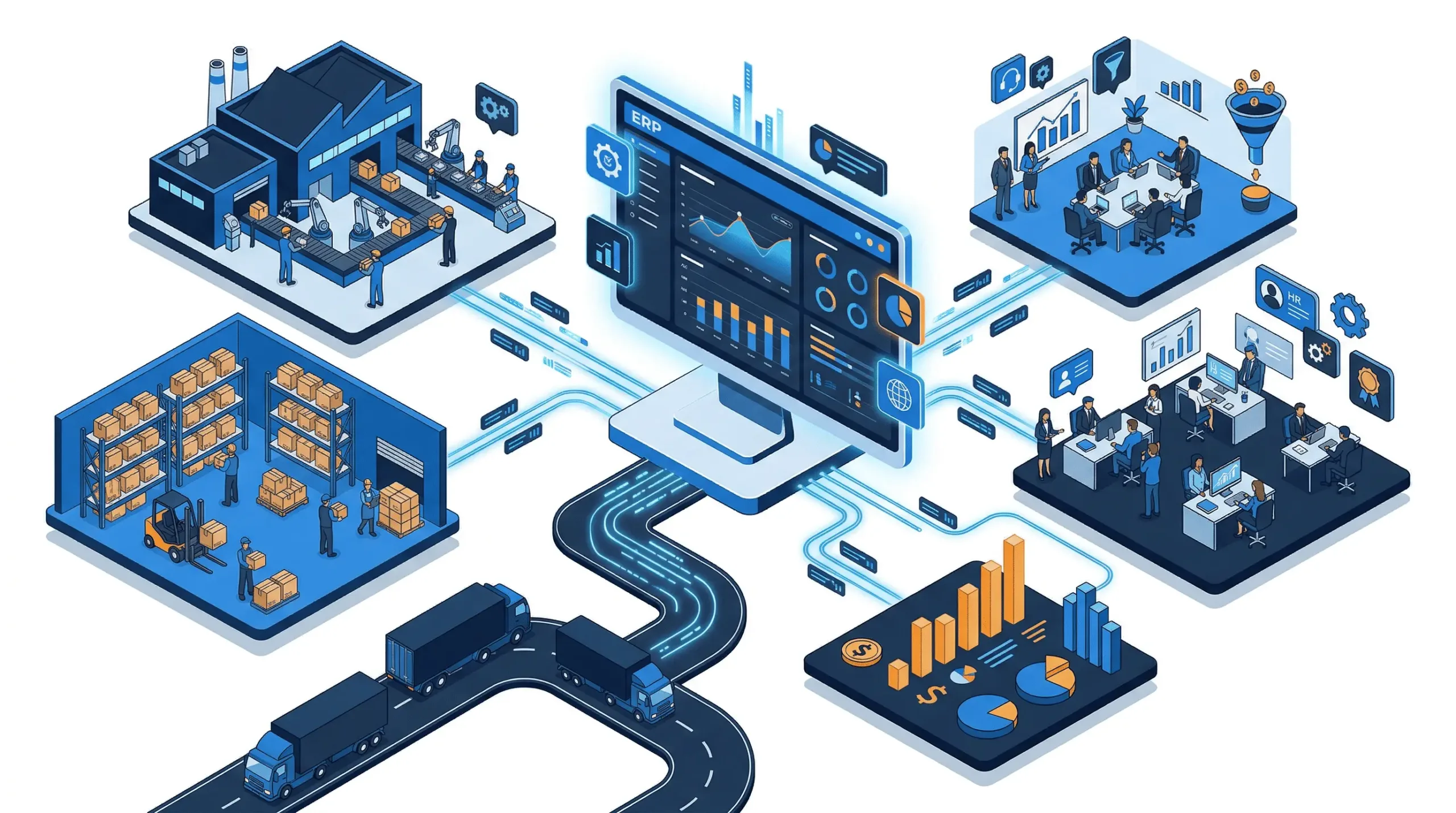
Enterprise Resource Planning software has traditionally been the domain of expensive, proprietary platforms that lock businesses into multi-year contracts, rigid workflows, and per-user licensing that penalises growth. ERPNext, built on the Frappe Framework, breaks that pattern. It is a 100% open-source, full-stack ERP platform that unifies accounting, inventory, manufacturing, HR, CRM, and project management into a single connected system — all without licensing fees.
Three forces make ERPNext especially relevant in 2026: rising proprietary ERP costs, open-source software reaching production-grade maturity, and the growing need for businesses to own their data without depending on vendor roadmaps.
For small and mid-sized enterprises across manufacturing, distribution, retail, and services, ERPNext represents a genuine alternative: lower total cost of ownership, faster deployment cycles, and complete flexibility to extend the platform as operations evolve. The project is hosted on GitHub with an active contributor community of over 600 developers worldwide.
02 — Pricing
How Much Does ERPNext Cost? Pricing and Total Cost of Ownership
| Cost Component | ERPNext | SAP / Oracle / Dynamics |
|---|---|---|
| Software License | $0 — free, open-source | $50,000 – $500,000+ |
| Per-User Fees | $0 — unlimited users | $50 – $250 / user / month |
| Implementation | $5,000 – $100,000+ | $50,000 – $1,000,000+ |
| Hosting | $50 – $500/month (Frappe Cloud, AWS, or self-hosted) | Bundled in subscription — vendor controlled |
| Annual Maintenance | $2,000 – $20,000 | 18–22% of license cost annually |
03 — Version 16
What Changed in ERPNext v16 and Why Should You Care?
ERPNext Version 16, released in January 2026, is widely considered the most significant upgrade in the platform's history. With contributions from over 600 developers and more than 50 new features, v16 represents a maturation of ERPNext from an SME-friendly tool into a genuinely enterprise-grade platform. Full release notes are available on the official ERPNext website.
Frappe Caffeine: Performance Overhaul
The headline improvement in ERPNext v16 is Frappe Caffeine, a comprehensive performance overhaul that delivers faster page loads, smoother transitions, reduced server load through intelligent caching, and better responsiveness under heavy data operations. For organizations processing hundreds of thousands of monthly transactions, this translates directly into measurable productivity gains.
Redesigned User Interface
v16 introduces a complete UI refresh with new icons, sidebars, and workspace layouts, making ERPNext competitive with the user experience standards set by SAP S/4HANA and Oracle Cloud.
Custom Financial Reporting and Compliance
Finance teams gain the ability to build custom financial statement templates without writing code. The consolidated trial balance feature lets multi-entity groups view combined financials in a single report — a long-requested enterprise feature.
Manufacturing and Supply Chain Improvements
v16 brings significant manufacturing enhancements: Phantom BOMs, advanced stock reservation, improved batch and serial handling, semi-finished goods tracking through Job Cards, and enhanced subcontracting workflows. These features close the gap with proprietary manufacturing-specific solutions.
Frappe HR and Payroll Enhancements
Frappe HR now includes overtime management rules that flow directly into payroll, arrears and loss-of-pay corrections, scheduled leave adjustments, multi-currency expense claims, and earned leave scheduling.

04 — India Compliance
ERPNext for Indian Businesses: GST, TDS, and Statutory Compliance
For Indian businesses, tax compliance is non-negotiable. ERPNext stands out because it handles Indian statutory requirements natively, without relying on third-party modules or expensive add-ons:
- GST Compliance Full CGST, SGST, IGST support. Automatic GST calculations on invoices, e-invoicing integration with the GST portal, e-way bill generation, and GST return-ready data — GSTR-1, GSTR-3B.
- TDS Management Automated TDS deduction on vendor payments, TDS certificate generation, and quarterly return data preparation built directly into the accounts module.
- EPF, ESI, and Professional Tax Employee provident fund, employee state insurance, and professional tax calculations integrated directly into payroll processing through Frappe HR.
- Indian Payroll Structures Support for both old and new tax regimes, salary component structures common in Indian organisations, and statutory deduction reporting.
- Tally Migration Path ERPNext supports structured data migration from Tally including chart of accounts, opening balances, masters, and historical transactions.
05 — Impact Areas
Where Does ERPNext Deliver the Most Impact?
ERPNext for Manufacturing Operations
ERPNext's manufacturing module covers the entire production lifecycle: multi-level bill of materials, production planning tied to sales orders and stock levels, work orders with operation tracking, quality inspection workflows, and batch or serial number traceability. With v16's improvements to MRP planning and subcontracting, the platform now handles complex, multi-stage production environments that were previously the exclusive domain of proprietary solutions.

Multi-Warehouse Inventory and Distribution
For businesses operating across multiple warehouses, ERPNext provides real-time stock visibility, automated reorder rules, batch and expiry tracking, and inter-warehouse transfer workflows. Every stock movement — from purchase receipt to delivery note — is automatically reflected in the accounting ledger, eliminating the reconciliation problem entirely.
ERPNext for HR, Payroll, and Workforce Compliance
Managing HR and payroll for large operational workforces is one of the most complex challenges businesses face. ERPNext, combined with Frappe HR, provides a unified system for the entire employee lifecycle: onboarding, attendance, leave management, payroll processing, tax compliance, and separation. Auriga IT has deployed this for organisations with 12,000+ employees across 100+ sites.
ERPNext for Financial Operations and Accounting
ERPNext's accounting module handles multi-currency transactions, automatic tax calculations, bank reconciliation, and customizable chart of accounts. With v16's custom financial statement templates and consolidated reporting, the platform is suitable for enterprises that need CFO-ready financial management rather than basic bookkeeping.
06 — Real-World Results
Real-World Results: How Are Enterprises Winning with ERPNext?
The best way to evaluate any ERP platform is through the results it delivers in production. Here are four real-world ERPNext implementations led by Auriga IT, each organised by business function so the relevant pattern is easy to find regardless of industry.
Kapila Krishi Udyog
Moving multi-plant agribusiness operations from a legacy desktop ERP to cloud ERPNext.
Procurement & Inward
Gate-to-warehouse movement, quality assessment, and supplier payments had no system link between them.
- Vehicle entry, weighbridge data, and purchase tokens captured at the factory gate
- Lab Deduction Rule calculates price deductions automatically based on moisture, protein, and grade
- Bill Pass Advice processes supplier payment only after quality clearance
Sales & Order to Cash
Dealer credit limits, dispatch tracking, and GST compliance were managed across disconnected steps.
- Sales Order screen shows real-time ledger balance and credit limit per dealer before confirmation
- Token-wise tracking runs from Sales Order through godown dispatch to invoice
- Delivery Notes flow into Sales Invoices with e-Waybill generation for GST compliance
Stock & Production
Warehouse-wise stock and production data across plants required cross-plant calls to piece together.
- Warehouse-wise stock balances visible in real time across all 5 plants
- Stock Ledger and Production Register available on demand for reorder and dispatch decisions
Finance & Controls
Bank reconciliation, tax compliance, and financial governance required manual effort across multiple tools.
- Finance team sees consolidated payables, receivables, GST, and bank position across all plants
- Bank statement reconciliation integrated directly; TDS and GST registers available without manual effort
- Role-based access configured across all functions and plant locations
Avanti Overseas
Connecting buyer orders to procurement, production, job work, and shipment in export manufacturing.
Order Planning & Pre-Production
Buyer requirements, BOMs, and timelines lived in spreadsheets with no structured link to procurement and production start.
- Buyer requirements, specifications, and quantities captured in one order screen
- Bill of Materials finalised before procurement and production begin
- Time and Action planner shows planned vs actual progress with delays visible before ship date
Procurement & Receipt Control
Material ordering, gate entry, and receipt confirmation were disconnected — teams could not see what had physically arrived.
- Purchase flow linked to buyer orders, showing ordered, received, and pending material
- Gate pass confirms physical movement before material enters the system
- Quality clearance ensures only accepted material moves forward
Production, Job Work & Shipment
Production progress, consumption, and shipment readiness were tracked separately — confirming whether an order would ship required calls across teams.
- Sales Order-wise report shows manufactured quantity, issued material, and balance quantity
- Daily consumption limit on work orders prevents over-issuing before it happens
- Order-wise readiness view shows production progress, pending material, and dispatch status
Kindlife
Connecting procurement, warehouse, B2B and B2C commerce, and AI-automated workflows on one platform.
Procurement & Inward
Purchase orders, vendor coordination, and goods receipt had no single flow — stock visibility started late and inaccurate.
- Purchase Order to Goods Receipt Note runs in one digital flow with barcode tagging at receipt
- Putaway follows FEFO logic from the moment goods arrive; stock levels update in real time
Inventory & Warehouse
Expiry-date discipline across 10,000+ SKUs depended on manual effort, with pick errors and near-expiry stock moving last as constant risks.
- Every batch captured with expiry data at receipt; FEFO enforced automatically through the outbound flow
- Auto-generated picklists with guided picking and barcode scan at outward
B2B & B2C Orders
Two sales channels ran on separate processes — stock, pricing, and order status were never in one place.
- B2C orders sync in real time with ERPNext; product, price, and stock updated automatically
- Stock reserved at order placement, reducing overselling risk before fulfilment begins
- B2B wholesale runs on the same platform with channel-aware pricing
AI — CygnusAlpha
Routine tasks like buyer purchase order processing moved through email, manual checks, and manual entry — slow and error-prone.
- Teams build agents inside CygnusAlpha for daily reports, recurring tasks, and exception alerts connected to ERPNext
- A buyer purchase order received over WhatsApp or email is read, line items extracted, pricing checked, exceptions flagged, and the order created in ERPNext without manual entry
A2Z Group
Connecting workforce operations, payroll, and client contracts on one platform for 12,000+ employees.
Onboarding & Attendance
Employee entry, document verification, and attendance across sites depended on manual processes with no location verification.
- Aadhaar-based onboarding with document validation before system access
- Geo-fencing captures location-verified check-ins across all sites
- Overtime calculated automatically from attendance; supervisors manage rosters from a web interface
Employee & Client App
Employees had no self-service access, and clients had no visibility into deployed staff, attendance, or invoices.
- Mobile app with OTP and biometric login for employees to view salary slips, apply for leave, and update documents
- Clients log in to verify deployed employees, view attendance, and approve invoices against their contract
Payroll & Compliance
Payroll was run as a consolidated batch with no visibility into what each site or contract actually cost.
- Salary sheet generated per site and per contract, mapped to cost centres for site-wise profitability in ERPNext
- PF, ESI, Professional Tax, Labour Welfare Fund, Bonus, and arrear calculations handled within the payroll cycle
Finance & Operations
HR and accounts ran on separate systems — reconciling the two was a recurring manual effort.
- Purchase, sales, accounting, and asset management implemented alongside HR on one platform
- Finance works from one system; no reconciliation between HR and accounts required
07 — ERP + AI
ERP and AI: How CygnusAlpha Builds on ERPNext
You do not need an "AI-native" ERP to use AI. AI is a layer that sits on top of structured business data. ERPNext, configured with clean master data and consistent transaction discipline, provides exactly the foundation AI needs. Three conditions must be true first.
- Clean, structured data One system of record — not scattered across WhatsApp, email, and spreadsheets.
- Defined workflows and approvals Clear rules for AI to act within, and clear exceptions for it to route to a human.
- Consistent transactions Repeatable patterns in how purchase orders, invoices, and approvals are recorded are what make automation reliable rather than noisy.
From a Customer Purchase Order to a Confirmed Order
Here is what the difference looks like in a single, common workflow: a customer sends a purchase order with 40 line items, negotiated prices, and delivery dates — over email or WhatsApp.
Manual flow
A coordinator retypes every line into ERPNext, checks each price against the agreed list by hand, pings finance for credit limit and checks stock manually, then creates the Sales Order. Errors surface later as rework. Hours of effort, transcription mistakes, and delayed confirmation are the norm.
With CygnusAlpha
AI reads the purchase order in any format — email, PDF, WhatsApp, or image — extracts line items, quantities, prices, and delivery dates, auto-checks the price list, stock, and credit limit, flagging only exceptions, then creates a draft Sales Order for one-click approval. The team reviews exceptions, not data entry, and ERPNext stays in sync throughout.
08 — Partner Selection
How Do You Choose the Right ERPNext Implementation Partner?
Roughly 70% of ERP implementations fall short of their original business goals — almost never because of the technology itself, but because process mapping, requirement ownership, data migration, and adoption were weak. Here is what to look for in a partner.
- Official Frappe Partner Certification Ensures the team has been trained and audited by the core maintainers of ERPNext.
- Industry-Specific Experience An ERP deployment for a multi-factory manufacturer is fundamentally different from one for a distribution company or a services firm.
- Track Record at Scale Your partner should have handled implementations with 5,000+ users, complex payroll, multi-warehouse inventory, and real-time reporting.
- Post-Deployment Support The first 90 days after go-live are critical. Your partner should offer optimization support, training, and ongoing maintenance.
- Custom Development on Frappe Framework If your business needs features beyond standard ERPNext, the partner should have the engineering depth to build custom apps.
09 — Engagement Models
Engagement Models: QuickStart, Full Implementation, or Retainer
Choosing the right starting point depends on clarity of requirements, operational complexity, and how fast the business wants to move. The first conversation usually makes the right model obvious.
Auriga QuickStart
A focused first phase to move from scattered tools to a working ERP foundation: core modules, master migration, training, go-live support, and hypercare.
Best for: Businesses moving from Excel, Tally, or WhatsApp where processes are mostly standard.
Packaged scopeFull ERP Implementation
A discovery-led implementation for businesses with multiple functions, locations, workflows, integrations, approvals, and data-migration needs.
Best for: Multi-location operations, manufacturing complexity, legacy systems, custom workflows.
Fixed after discoveryERP Retainer
A dedicated monthly engagement for ongoing rollout, support, improvements, reports, integrations, automation, and workflow changes.
Best for: Businesses already live or going live who prefer iterative delivery with dedicated support.
Monthly, min 3 months10 — Pricing Process
How ERPNext Pricing Actually Gets Finalised
The biggest driver of ERPNext implementation cost is not the software — which is free — but the gap between standard workflows and custom requirements. Getting a fixed, defensible number means walking through five steps rather than quoting off a single conversation.
Initial Discussion
Understand your needs and share an indicative ballpark range.
Structured Discovery
AS-IS / TO-BE mapping, module scope, and fit-gap analysis.
Scope & Fit-Gap
Freeze what is standard versus custom — the main price driver.
Effort, Timeline & Risk
Realistic effort and timeline with clear assumptions and exclusions.
Final Commercial / SOW
One clear, fixed proposal with milestone-based payments.
11 — Comparison
How Does ERPNext Compare to SAP, Oracle, and Other Proprietary ERPs?
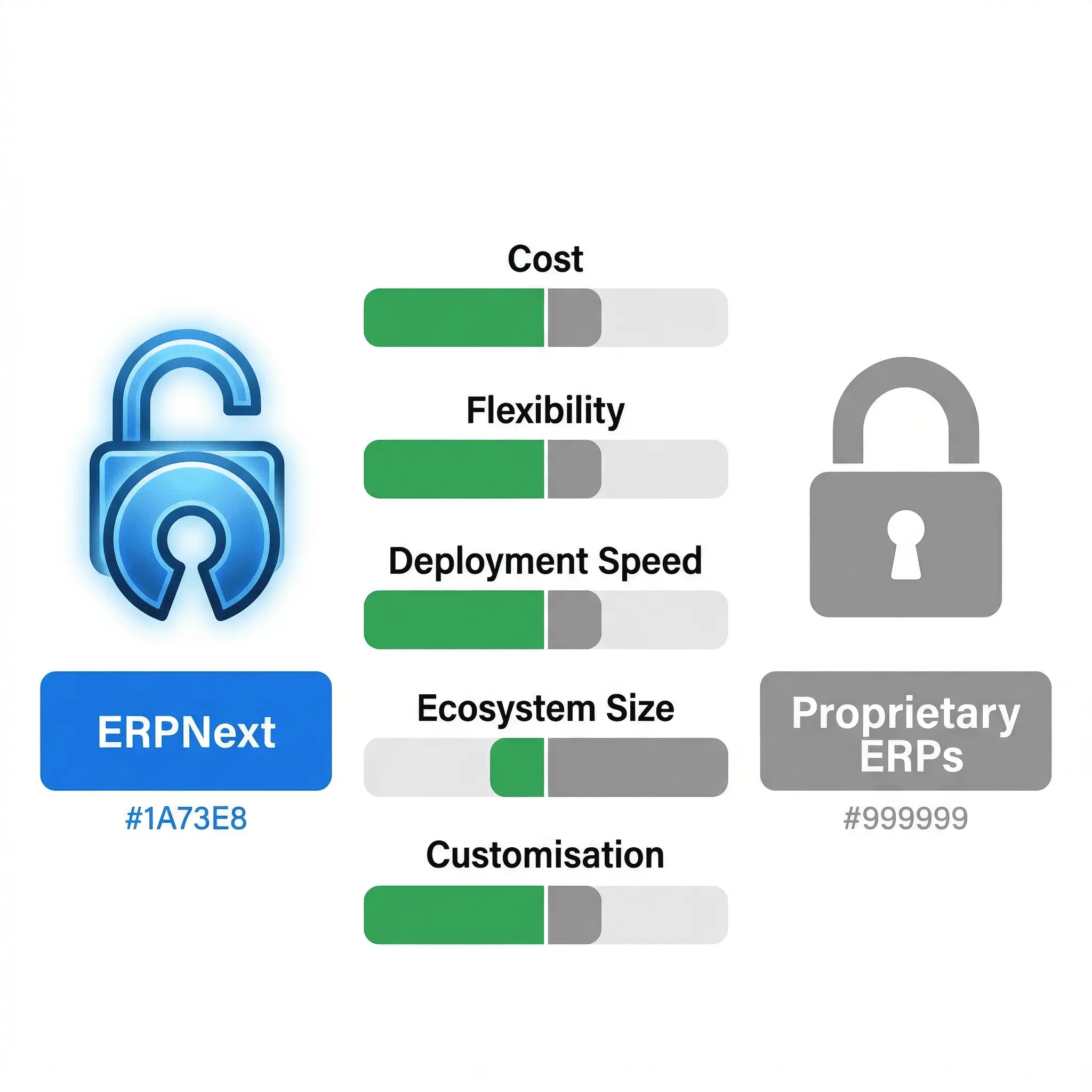
| Category | ERPNext | SAP / Oracle / Dynamics |
|---|---|---|
| Licensing Cost | 100% free — AGPL v3. No per-user fees. | High-cost, user-based pricing with multi-year contracts. |
| Customization | Deep flexibility through Frappe Framework. Full source code access. | Possible within constrained boundaries, often at significant additional cost. |
| Deployment Speed | Focused: 8 weeks. Broader rollout: 3–6 months. | Typically 12–24 months for comparable scope. |
| Data Ownership | Full ownership — cloud, self-hosted, or on-premises. | Vendor lock-in with limited infrastructure control. |
| Ecosystem | Fast-growing global community — 200+ certified partners across 30+ countries. | Larger legacy ecosystem, but more closed and expensive to participate in. |
| Total Cost of Ownership | 50–90% lower TCO for comparable functionality. | Six- to seven-figure initial investments plus ongoing per-user and maintenance fees. |
12 — ERPNext vs Odoo
ERPNext vs Odoo: Which Open-Source ERP Is Better?
| Dimension | ERPNext | Odoo |
|---|---|---|
| License | 100% open-source — AGPL v3. All modules free. | Community: 1 free app. Enterprise: proprietary, per-user fees. |
| All-In-One Cost | $0 for software. Pay only hosting and implementation. | $24–36/user/month for Enterprise with all apps. |
| Indian Compliance | Native GST, TDS, EPF, ESI, e-invoicing, e-way bills. | GST via community modules. Less native Indian compliance. |
| Manufacturing | Multi-level BOM, MRP, Phantom BOMs, Job Cards, subcontracting. | BOM, MRP, work orders. Full features require Enterprise. |
| App Ecosystem | Growing — 200+ certified partners. Custom apps via Frappe. | Larger marketplace — 40,000+ third-party apps. |
| Deployment Speed | 3–6 months for comprehensive rollout. | 4–9 months for Enterprise. Faster for Community (limited scope). |
13 — Roadmap
How Do You Get Started with ERPNext Implementation?
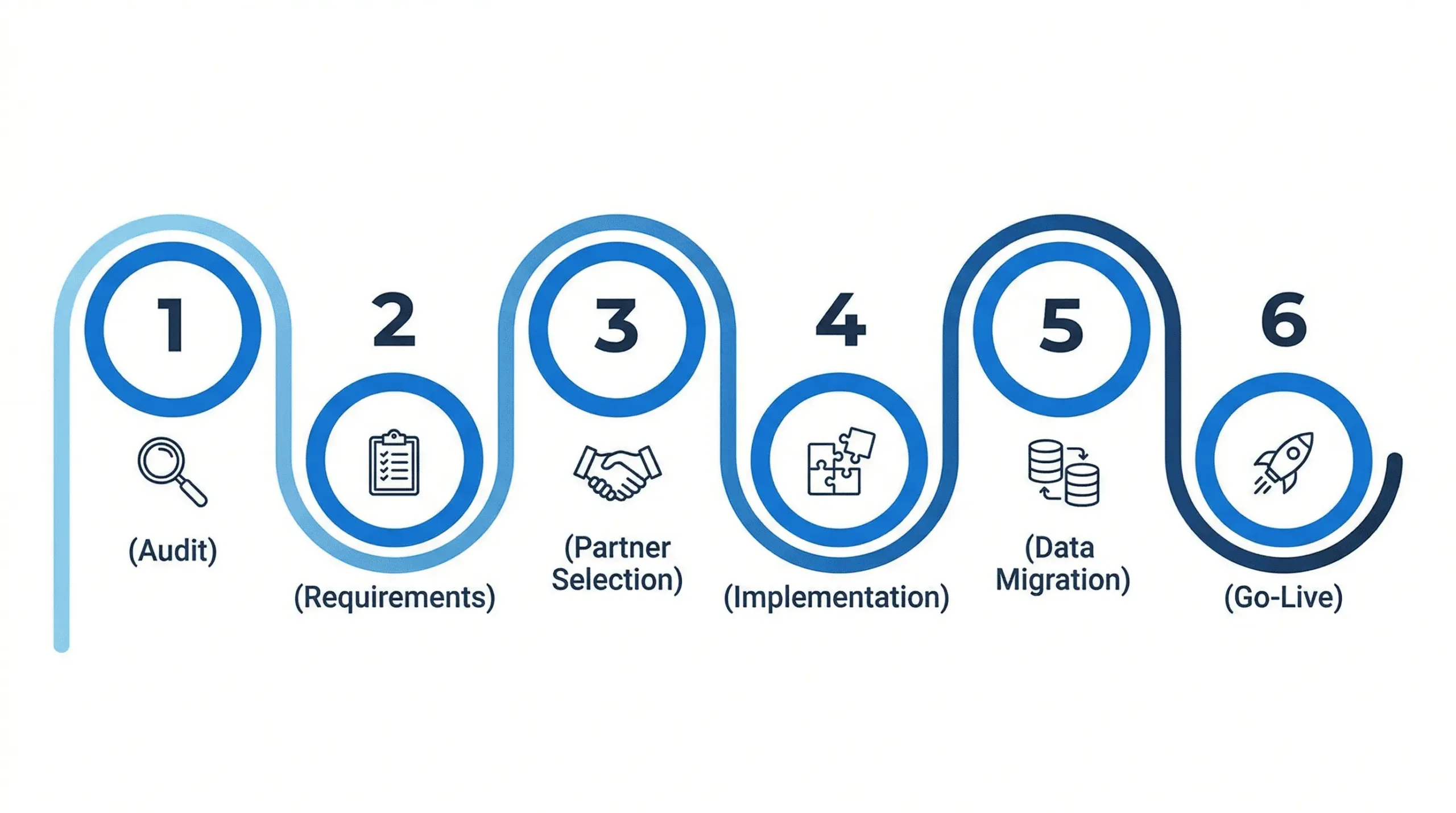
Whether you are replacing a legacy system, consolidating disconnected tools, or implementing ERP for the first time, here is a practical 6-step roadmap for a successful ERPNext deployment.
Process Audit
Map your current workflows across finance, operations, HR, and sales. Identify pain points, data silos, and manual bottlenecks.
Requirements Definition
Define your must-have modules, integration requirements, user roles, and compliance needs.
Partner Selection
Choose a certified Frappe Partner with relevant industry experience and a proven track record at your scale.
Phased Implementation
Start with your highest-impact modules — usually accounting + inventory or HR + payroll — then expand.
Data Migration & Testing
Clean, validate, and migrate your historical data. Run parallel operations before full cutover.
Training & Go-Live
Train your team on the new system, go live with support, and optimise during the first 90 days.
14 — Frequently Asked Questions
Frequently Asked Questions About ERPNext
ERPNext is a 100% open-source enterprise resource planning platform built on the Frappe Framework. The software is free under the AGPL v3 license with no per-user fees or feature paywalls. Costs typically include cloud hosting (starting at $50/month on Frappe Cloud) and professional implementation services when needed.
Yes. ERPNext v16 introduced Frappe Caffeine, a performance overhaul that enables the platform to handle large datasets and high-transaction volumes reliably. Organisations with 12,000+ employees across 100+ sites use ERPNext successfully when deployed by experienced implementation partners like Auriga IT.
Yes. ERPNext includes multi-level BOM management, Material Requirements Planning (MRP), work order tracking, quality inspection, batch and serial number tracing, subcontracting workflows, and Job Card tracking for semi-finished goods. Version 16 added Phantom BOMs and advanced stock reservation — significantly closing the gap with manufacturing-specific proprietary solutions.
ERPNext is widely deployed in manufacturing, distribution, retail, services, education, healthcare, and agriculture. It is particularly strong for mid-sized enterprises that need integrated operations management without the cost and complexity of proprietary alternatives. Its native Indian compliance also makes it the leading ERP choice for Indian businesses.
Typical comprehensive ERPNext deployments take 3–6 months. Focused implementations covering 1–2 modules can go live in as little as 8 weeks. Timeline depends on scope, data migration complexity, and organisational readiness. Multi-location or manufacturing implementations at the higher end of complexity take closer to 6 months.
Frappe HR is a dedicated open-source HR and payroll application that connects directly with ERPNext. It covers the full employee lifecycle: recruitment, onboarding, attendance, leave management, payroll processing, expense management, tax compliance, and employee separation. In ERPNext v16, Frappe HR gained overtime management, arrears processing, and multi-currency expense claims.
Yes. ERPNext has built-in support for Indian GST including CGST, SGST, IGST, e-invoicing, e-way bills, and GST return data (GSTR-1, GSTR-3B). It also supports TDS, EPF, ESI, Professional Tax, and Indian payroll structures natively — no third-party plugins required. This makes ERPNext the most compliance-ready open-source ERP for Indian businesses.
ERPNext can be hosted three ways: Frappe Cloud (fully managed, starting around $50/month), self-hosted on your own servers for maximum control, or deployed on cloud providers like AWS, DigitalOcean, or Azure. Most businesses start with Frappe Cloud and migrate to self-hosted as they scale and need more infrastructure control.
Yes. ERPNext supports data migration from Tally including chart of accounts, opening balances, customer and supplier masters, item masters, and historical transactions. A certified partner like Auriga IT manages the complete migration with data validation and parallel running before cutover — ensuring no data is lost in the transition.
Yes. ERPNext is one of the best ERP options for small businesses because of zero licensing fees, all modules included from day one, and affordable hosting starting at $50/month on Frappe Cloud. Small businesses can start with just accounting and inventory, then activate more modules as they grow — without any additional software cost.
For mid-scale or complex ERP projects involving multiple modules, multi-location operations, customisation, integrations, or data migration, a paid structured discovery phase maps current and future workflows in detail before a fixed-cost proposal is issued. This protects both sides from a quote based on assumptions rather than verified scope — the most common reason ERP projects go over budget.
Auriga IT is a Jaipur-based technology consulting firm and certified Frappe Partner with 16+ years of experience, 300+ team members, and 1,000+ delivered projects across 500+ clients. They specialise in ERPNext implementations for manufacturing, HR and payroll, supply chain, and financial operations — with proven deployments for organisations with 12,000+ employees across 100+ sites.
15 — Final Thoughts
The Bottom Line on ERPNext in 2026
ERPNext has matured into an enterprise-ready platform that competes directly with proprietary systems costing ten to fifty times more. The software is free. The real question is whether you can afford to keep running on disconnected spreadsheets, legacy systems, or overpriced proprietary platforms.
The businesses that get the most out of ERPNext — as the case studies above show — treat implementation as an operating discipline: clear process mapping, named ownership, validated data migration, and adoption tracked as the real measure of go-live. Visit aurigait.com to explore how Auriga IT can help your business get there.
Ready to Build on ERPNext?
If you are evaluating ERPNext for manufacturing, HR, payroll, supply chain, or finance, our team can help you turn planning into a rollout that actually works.
Talk to Our ERPNext Team →Related content

Auriga: Leveling Up for Enterprise Growth!
Auriga’s journey began in 2010 crafting products for India’s [...]