- Digital Products & Software
ERPNext in 2026: The Definitive Guide to Open-Source ERP for Growing Businesses
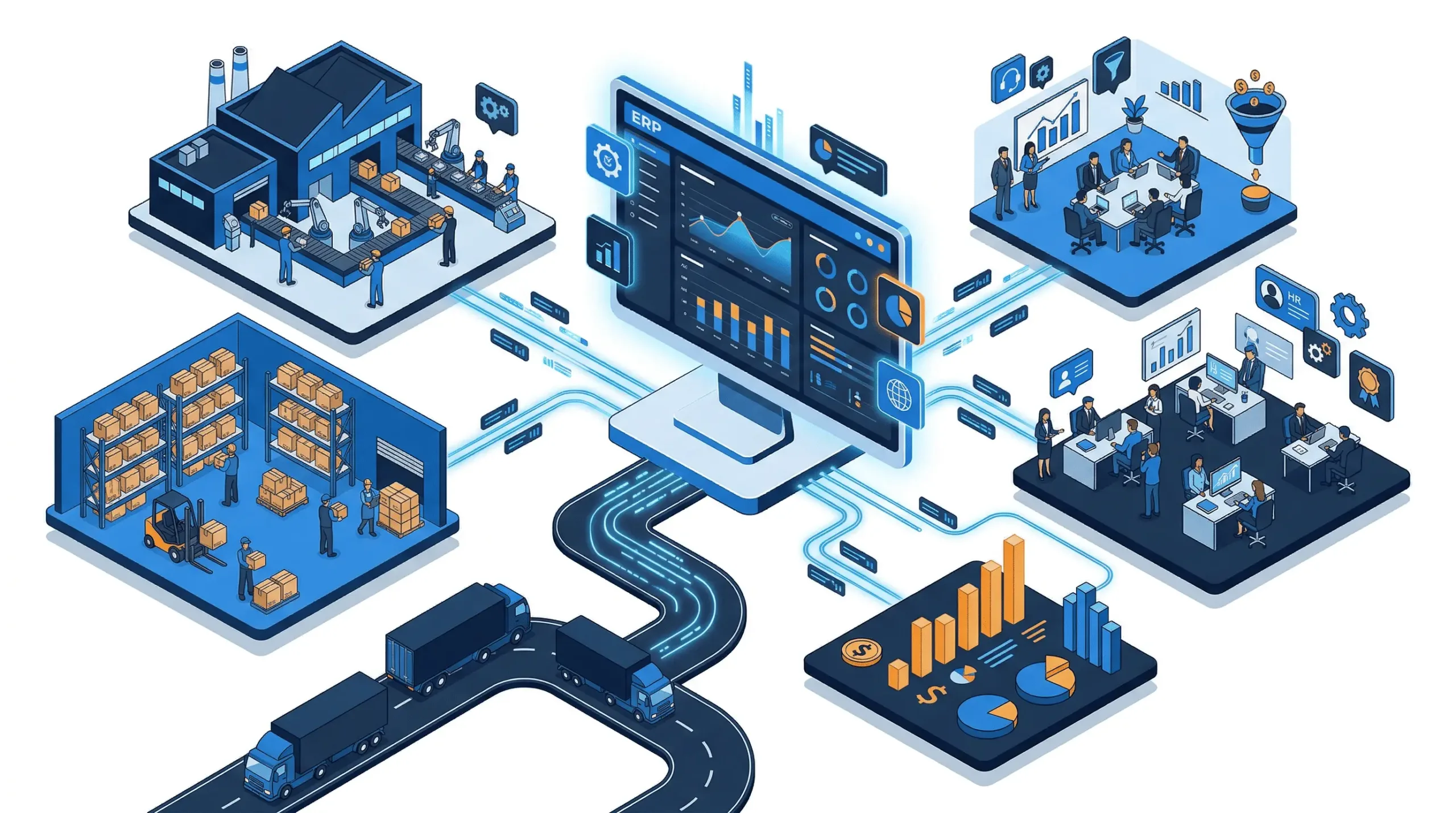
ERPNext in 2026: The Definitive Guide to Open-Source ERP for Growing Businesses
ERPNext in 2026: The Definitive Guide to Open-Source ERP for Growing Businesses
ERPNext has evolved into one of the most practical ERP choices for growing companies. In 2026, rising proprietary ERP costs, stronger open-source maturity, and ERPNext v16's upgrades make it a serious option for manufacturers, distributors, service businesses, and multi-location enterprises.
· By Auriga IT
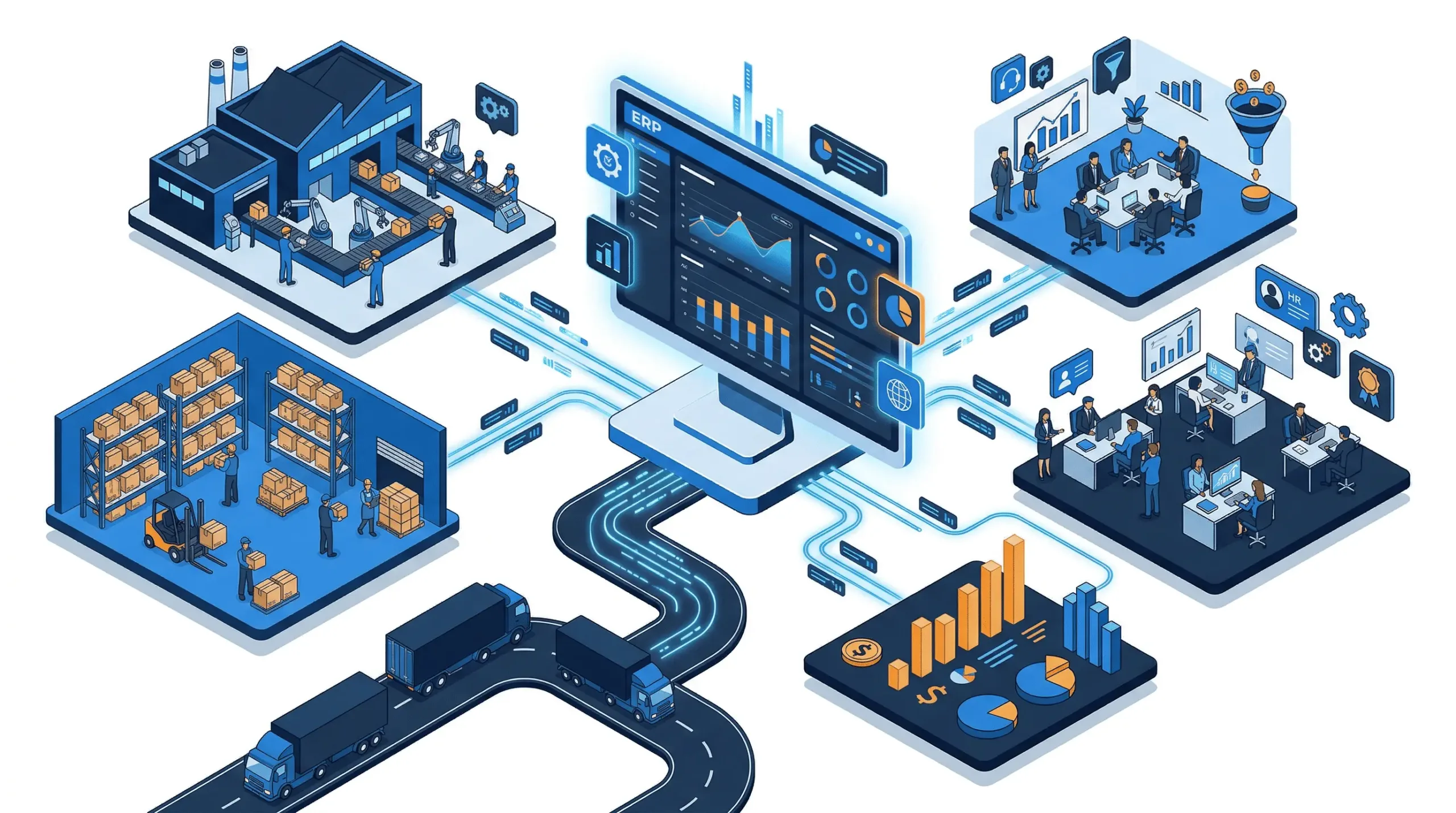
What Is ERPNext and Why Does It Matter in 2026?
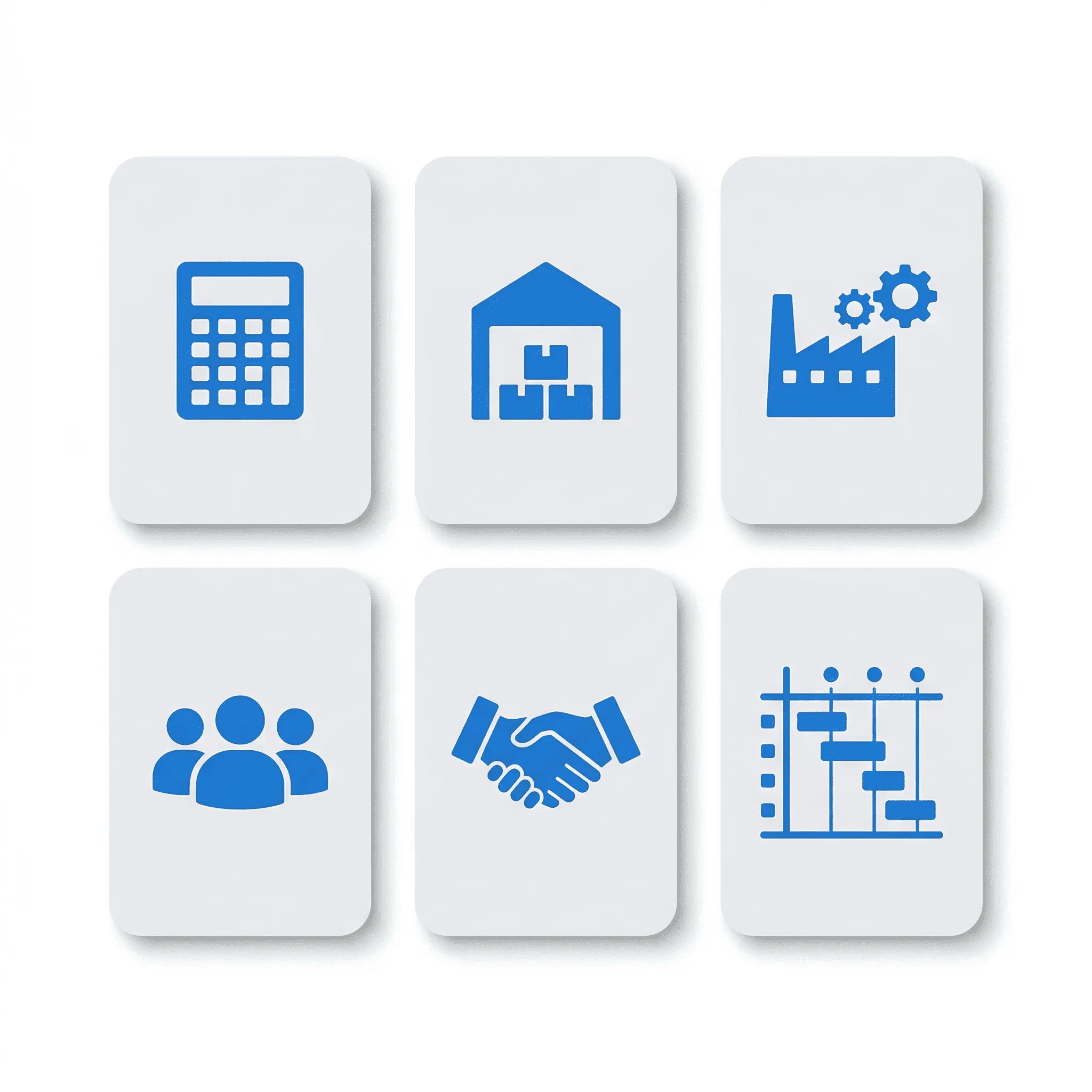
Enterprise Resource Planning software has traditionally been the domain of expensive, proprietary platforms that lock businesses into multi-year contracts, rigid workflows, and per-user licensing models that punish growth. ERPNext, built on the Frappe Framework, breaks that pattern. It is a 100% open-source, full-stack ERP platform that unifies accounting, inventory, manufacturing, HR, CRM, and project management into a single connected system — all without licensing fees.
What makes ERPNext especially relevant in 2026 is the convergence of three forces: the rising cost of proprietary ERP platforms like SAP and Oracle NetSuite, the maturation of open-source enterprise software into production-grade reliability, and the growing need for businesses to own their data and customize their workflows without depending on vendor roadmaps.
For small and mid-sized enterprises across manufacturing, distribution, retail, and services, ERPNext represents a genuine alternative: lower total cost of ownership, faster deployment cycles, and complete flexibility to extend the platform as operations evolve.
Who is ERPNext best for? Manufacturers managing complex bills of materials and production planning, distribution companies running multi-warehouse operations, service firms tracking projects and billing, and any growing enterprise that needs HR, payroll, and accounting on a single platform.
ERPNext v16: What Changed and Why You Should Care
ERPNext Version 16, released in January 2026, is widely considered the most significant upgrade in the platform's history. With contributions from over 600 developers and more than 50 new features, v16 represents a maturation of ERPNext from an SME-friendly tool into a genuinely enterprise-grade platform.
Frappe Caffeine: Performance Overhaul
The headline improvement is Frappe Caffeine, a comprehensive performance overhaul that delivers noticeably faster page loads, smoother transitions between views, reduced server load through intelligent caching, and better responsiveness under heavy data operations. For organizations processing hundreds of thousands of monthly transactions, this translates directly into productivity gains.
Redesigned User Interface
v16 introduces a complete UI refresh with new icons, sidebars, and workspace layouts. The redesign makes ERPNext competitive with the user experience standards set by platforms like SAP S/4HANA and Oracle Cloud.
Custom Financial Reporting and Compliance
Finance teams gain the ability to build custom financial statement templates without writing code. The consolidated trial balance feature lets multi-entity groups view combined financials in a single report.
Manufacturing and Supply Chain Improvements
v16 brings significant manufacturing enhancements: Phantom BOMs, advanced stock reservation, improved batch and serial handling, semi-finished goods tracking through Job Cards, and enhanced subcontracting workflows.
Frappe HR and Payroll Enhancements
Frappe HR now includes overtime management rules that flow directly into payroll, arrears and loss-of-pay corrections, scheduled leave adjustments, multi-currency expense claims, and earned leave scheduling.

Where ERPNext Delivers the Most Impact
ERPNext for Manufacturing Operations
ERPNext's manufacturing module covers the entire production lifecycle: multi-level bill of materials, production planning tied to sales orders and stock levels, work orders with operation tracking, quality inspection workflows, and batch or serial number traceability. With v16's improvements to MRP planning and subcontracting, the platform now handles complex, multi-stage production environments that were previously the exclusive domain of proprietary solutions.

Multi-Warehouse Inventory and Distribution
For businesses operating across multiple warehouses, ERPNext provides real-time stock visibility, automated reorder rules, batch and expiry tracking, and inter-warehouse transfer workflows. Every stock movement — from purchase receipt to delivery note — is automatically reflected in the accounting ledger.
ERPNext for HR, Payroll, and Workforce Compliance
Managing HR and payroll for large operational workforces is one of the most complex challenges businesses face. ERPNext, combined with Frappe HR, provides a unified system for the entire employee lifecycle: onboarding, attendance, leave management, payroll processing, tax compliance, and separation.
Auriga IT: ERPNext Implementation Spotlight
Auriga IT, an official Frappe Partner based in Jaipur, has built deep expertise in deploying ERPNext and Frappe HR for large-scale enterprises. Their implementations include custom HRMS platforms for organizations with 10,000+ employees across manufacturing, facility management, mining, and infrastructure.
ERPNext for Financial Operations and Accounting
ERPNext's accounting module handles multi-currency transactions, automatic tax calculations, bank reconciliation, and customizable chart of accounts. With v16's custom financial statement templates and consolidated reporting, the platform is suitable for enterprises that need CFO-ready financial management rather than basic bookkeeping.
Real-World Results: How Enterprises Are Winning with ERPNext
The best way to evaluate any ERP platform is through the results it delivers in production. Here are seven real-world ERPNext implementations that demonstrate measurable outcomes when deployed by an experienced partner.

Case Study 1: Custom HR and Payroll Platform for 12,000+ Employees Across 100+ Sites
Challenge: A large Indian enterprise with over 12,000 employees across more than 100 operational sites was struggling with fragmented HR systems, manual payroll processing, inconsistent attendance tracking, and compliance gaps across multiple states.
Solution: Auriga IT designed and implemented a custom HR and payroll platform built on Frappe HR, featuring automated shift-based attendance tracking, region-specific payroll rules, statutory compliance for PF/ESI/PT, and centralized employee lifecycle management.
Impact: Payroll processing time reduced dramatically. Compliance errors virtually eliminated. A single source of truth for 12,000+ employee records across 100+ sites.
Case Study 2: Connecting Every Warehouse, Order, and Supply Chain Operation in Real Time
Challenge: A growing distribution business was operating with disconnected systems for warehouse management, order processing, and supply chain coordination — leading to inventory inaccuracies, delayed order fulfilment, and poor visibility.
Solution: Auriga IT implemented ERPNext as a unified platform, connecting every warehouse, sales order, purchase cycle, and logistics workflow into a single real-time system.
Impact: End-to-end supply chain visibility. Significant reduction in order processing time. Inventory accuracy improved to near-100% through automated stock reconciliation.
Case Study 3: Unifying Multi-Factory Operations Through ERP Transformation
Challenge: A multi-factory manufacturing enterprise operating across geographically dispersed production facilities needed to unify its operations under a single ERP. Legacy systems and manual processes were creating data silos, production delays, and reporting inconsistencies.
Solution: Auriga IT deployed ERPNext with a cloud-based architecture that unified manufacturing, supply chain, and finance across all factory locations — including production planning, quality management, multi-warehouse inventory, and consolidated financial reporting.
Impact: Complete operational visibility across all factories. Eliminated data silos. Enabled real-time production tracking and consolidated financial reporting from a single dashboard.

Case Study 4: Custom HRMS Solution for Payroll Accuracy
Challenge: Chronic payroll errors, inconsistent attendance records, and difficulty managing complex salary structures across employee categories were creating compliance risks and employee dissatisfaction.
Solution: Auriga IT built a custom HRMS solution on the Frappe platform that automated attendance capture, salary computation, tax deductions, and payslip generation tailored to the organization's specific payroll rules.
Impact: Payroll accuracy improved to near 100%. Monthly processing time cut significantly. Employee grievances related to salary discrepancies reduced dramatically.
Case Study 5: Transforming Financial Operations with Frappe Framework and AI
Challenge: A financial services organization needed to modernize its financial operations, automate document processing, and reduce manual data entry across multiple accounting workflows.
Solution: Auriga IT built a custom financial operations platform on the Frappe Framework, integrating AI capabilities for document processing, automated data extraction, and intelligent workflow routing.
Impact: Significant reduction in manual processing time. Higher data accuracy through AI-powered extraction. Faster financial close cycles and improved audit readiness.
Case Study 6: Streamlining Repair Management with Low-Code Automation
Challenge: A service-oriented business was managing repair workflows, ticket tracking, and inventory for spare parts through disconnected manual processes — leading to delays, lost tickets, and poor customer communication.
Solution: Auriga IT developed a low-code automation platform that digitized the entire repair management lifecycle, from ticket creation and assignment through parts inventory, repair tracking, and customer notification.
Impact: Over 1,000 tickets processed monthly with full traceability. Repair turnaround times improved. Customer satisfaction increased through automated status updates.
Case Study 7: HRMS and Payroll Digitization for a Thailand-Based Fashion Manufacturer
Challenge: A Thailand-based athleisure fashion manufacturer needed to digitize its entire HR and payroll operations. Managing a multi-site workforce with diverse employment contracts, shift schedules, and Thai labor compliance requirements was creating administrative overhead and payroll inaccuracies.
Solution: Auriga IT implemented a unified HRMS and payroll system tailored for the Thai regulatory environment, automating the complete employee lifecycle from onboarding and attendance to payroll processing and statutory filings.
Impact: Complete digitization of HR operations. Payroll compliance with Thai labour regulations. Reduced administrative workload and improved accuracy across the workforce.

Choosing the Right ERPNext Implementation Partner
ERPNext is powerful, but like any ERP platform, the difference between a successful deployment and a failed one comes down to implementation quality. The platform itself is free. The value lies in how it is configured, customized, migrated, and supported.
Why businesses choose Auriga IT: Auriga IT is an official Frappe Partner with 16+ years of technology consulting experience, 1,000+ projects delivered, and a 300-person team spanning AI, data engineering, ERP, and UX design. Explore their ERP solutions at aurigait.com/services/erp-solutions.
ERPNext vs. SAP, Oracle, and Other Proprietary ERPs
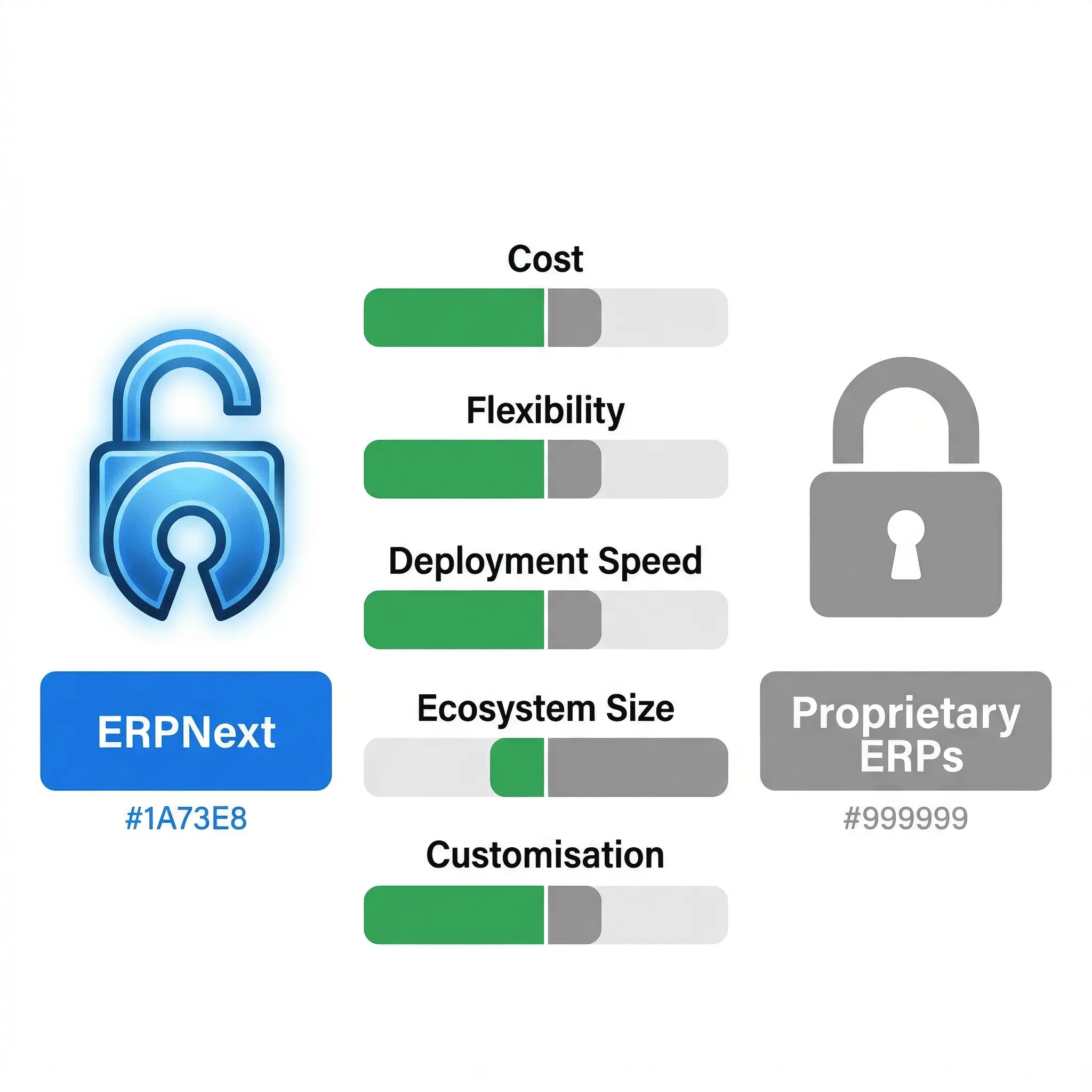
The most common question decision-makers ask is how ERPNext compares to established platforms like SAP Business One, Oracle NetSuite, and Microsoft Dynamics. Here is a candid comparison across the dimensions that matter most.
| Category | ERPNext | Proprietary ERP (SAP, Oracle, Dynamics) |
|---|---|---|
| Licensing Cost | 100% free and open-source under AGPL v3. No per-user fees or annual licensing costs. | High-cost, user-based pricing with multi-year contract commitments. |
| Customization | Deep flexibility through the Frappe Framework. Full source code access. | Possible within constrained boundaries, often at significant additional cost. |
| Deployment Speed | Focused implementations go live in 8 weeks. Broader rollouts take 3–6 months. | Typically 12–24 months for comparable scope. |
| Data Ownership | Full ownership with cloud, self-hosted, or on-premises deployment options. | Vendor lock-in with limited infrastructure control. |
| Ecosystem | Fast-growing global community with 200+ certified partners across 30+ countries. | Larger legacy ecosystem, but more closed and expensive to participate in. |
| Total Cost of Ownership | 50–90% lower TCO compared to proprietary alternatives for comparable scope. | Six- to seven-figure initial investments plus ongoing per-user and maintenance fees. |
Getting Started: Your ERPNext Implementation Roadmap
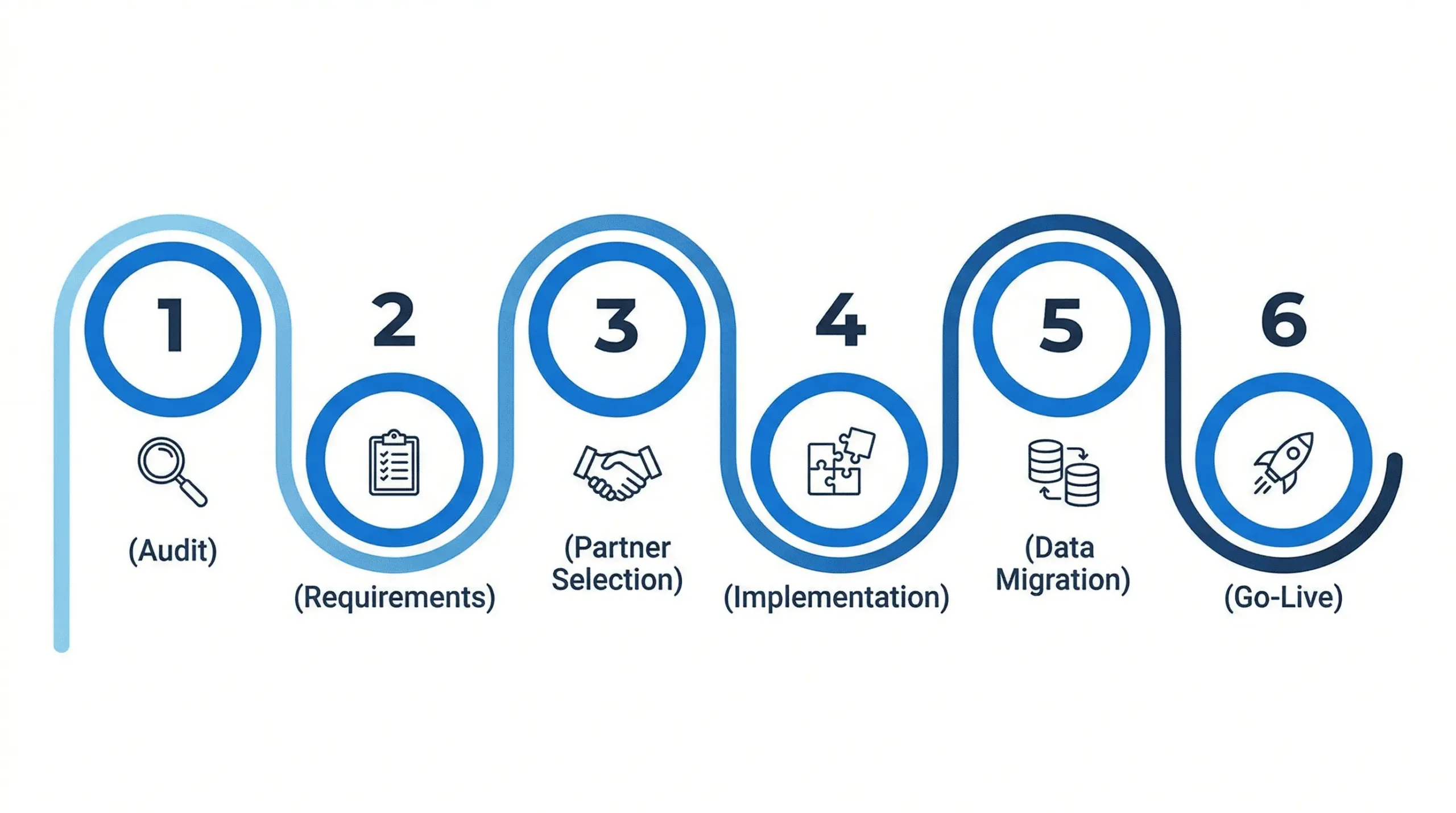
Whether you are replacing a legacy system, consolidating disconnected tools, or implementing ERP for the first time, here is a practical 6-step roadmap for a successful ERPNext deployment.
Ready to start your ERPNext implementation? Explore Auriga IT's ERPNext implementation services at aurigait.com/services/erp-solutions.
Frequently Asked Questions About ERPNext
What is ERPNext and is it really free?
ERPNext is a 100% open-source enterprise resource planning platform built on the Frappe Framework. The software is free under the AGPL v3 license with no per-user fees or feature paywalls. Costs typically include cloud hosting and, if needed, professional implementation services.
Is ERPNext suitable for large enterprises?
Yes. ERPNext v16 introduced Frappe Caffeine, a performance overhaul that enables the platform to handle large datasets and high-transaction volumes reliably. Organizations with 10,000+ employees use ERPNext successfully when deployed by experienced implementation partners.
How does ERPNext compare to SAP Business One?
ERPNext offers comparable core functionality — accounting, inventory, manufacturing, HR, and CRM — at a fraction of the cost. SAP offers a larger partner ecosystem and deeper industry templates, but ERPNext offers full customization flexibility, zero licensing costs, and faster deployment timelines (3–6 months vs. 12–24 months).
Can ERPNext handle manufacturing and production planning?
Yes. ERPNext includes multi-level BOM management, Material Requirements Planning (MRP), work order tracking, quality inspection, batch and serial number tracing, subcontracting workflows, and Job Card tracking for semi-finished goods. Version 16 added Phantom BOMs and advanced stock reservation.
What industries is ERPNext best suited for?
ERPNext is widely deployed in manufacturing, distribution, retail, services, education, healthcare, and agriculture. It is particularly strong for mid-sized enterprises that need integrated operations management without the cost and complexity of proprietary alternatives.
How long does an ERPNext implementation take?
Typical comprehensive deployments take 3–6 months. Focused implementations covering 1–2 modules can go live in as little as 8 weeks. Timeline depends on scope, data migration complexity, and organizational readiness.
What is Frappe HR and how does it relate to ERPNext?
Frappe HR is a dedicated open-source HR and payroll application that integrates seamlessly with ERPNext. It covers the full employee lifecycle: recruitment, onboarding, attendance, leave management, payroll processing, expense management, tax compliance, and employee separation.
What is ERPNext v16 and what are its key features?
ERPNext v16, released in January 2026, is the most significant upgrade in the platform's history. Key features include Frappe Caffeine for dramatically faster performance, a redesigned UI, custom financial statement templates, Phantom BOMs for manufacturing, advanced stock reservation, improved batch handling, and overtime management in Frappe HR.
What is the total cost of ownership for ERPNext?
ERPNext has zero software licensing fees. Total cost of ownership includes cloud hosting or server infrastructure, implementation services from a certified partner, data migration, training, and ongoing support. This typically results in 50–90% lower total cost compared to proprietary ERPs like SAP or Oracle NetSuite.
Who is Auriga IT and why should I consider them for ERPNext implementation?
Auriga IT is a Jaipur-based technology consulting firm and certified Frappe Partner with 16+ years of experience, 300+ team members, and 1,000+ delivered projects. They specialize in ERPNext implementations for manufacturing, HR and payroll, supply chain, and financial operations, with proven deployments for organizations with 10,000+ employees.
The Bottom Line on ERPNext in 2026

ERPNext has evolved from a promising open-source project into a mature, enterprise-ready platform that competes directly with proprietary systems costing ten to fifty times more. Version 16 marks a turning point: the combination of performance improvements, a redesigned interface, deeper financial and manufacturing capabilities, and a vibrant global community makes ERPNext one of the most compelling ERP choices for growing businesses in 2026.
The software is free. The real question is not whether you can afford ERPNext — it is whether you can afford to keep running on disconnected spreadsheets, legacy systems, or overpriced proprietary platforms.
Get started with a trusted ERPNext partner. Visit aurigait.com to explore how Auriga IT can help you plan, implement, and scale your ERPNext deployment.
Ready to Build on ERPNext?
If you are evaluating ERPNext for manufacturing, HR, payroll, supply chain, or finance, our team can help you turn planning into a rollout that actually works.
Talk to Our ERPNext Team →Related content

Auriga: Leveling Up for Enterprise Growth!
Auriga’s journey began in 2010 crafting products for India’s [...]